The Subterranean Cities of the Dead
How the overcrowded graves beneath Europe's great cities quietly shaped the world above
The Basement Wall
In 1780, in a neighborhood pressed tight against the oldest cemetery in Paris, a basement wall gave way. The weight of five centuries of dead—an estimated two million bodies layered into the earth of the Cimetière des Saints-Innocents—finally exceeded what the ground could hold. Rotting corpses spilled into a neighbor's cellar.i Think about that for a moment. Not a metaphor. Not a gothic novel. A real person, in a real house, finding the dead cascading through their wall like a dam breaking.
We tend to imagine that cities are built on bedrock, on planning, on foundations of rational thought. But the truth is stranger and more disturbing. Europe's greatest cities were built on top of the dead, and for centuries the dead were winning. They were poisoning the water, collapsing the streets, and crowding out the living. The crisis of what to do with all those bodies didn't just produce morbid curiosities and macabre tourist attractions—it reshaped public health, urban planning, criminal law, medical science, and our entire modern relationship with death. The cities of the dead, it turns out, built the cities of the living.
The Empire of Bone Beneath Paris
Paris is, geologically speaking, Swiss cheese. For centuries, Romans and then Parisians quarried the Lutetian limestone beneath the city to build the city above it, hollowing out a vast subterranean labyrinth. By the eighteenth century, the relationship between surface and void had become precarious: streets and entire houses were collapsing into the tunnels below. Paris was eating itself from within. And into this already unstable underworld, the city decided to pour its dead.
After the basement wall catastrophe at Les Innocents, intramural burials were banned, and between 1785 and 1787, the remains of roughly two million Parisians were exhumed and transported to the disused Tombe-Issoire quarry shafts. The transfer happened at night—always at night—with ox carts draped in black cloth, escorted by chanting priests. The processions were designed to prevent scandal, but they must have been terrifying to anyone who happened to look out their window: the city secretly disgorging its dead under cover of darkness, a liturgical parade of bone.ii
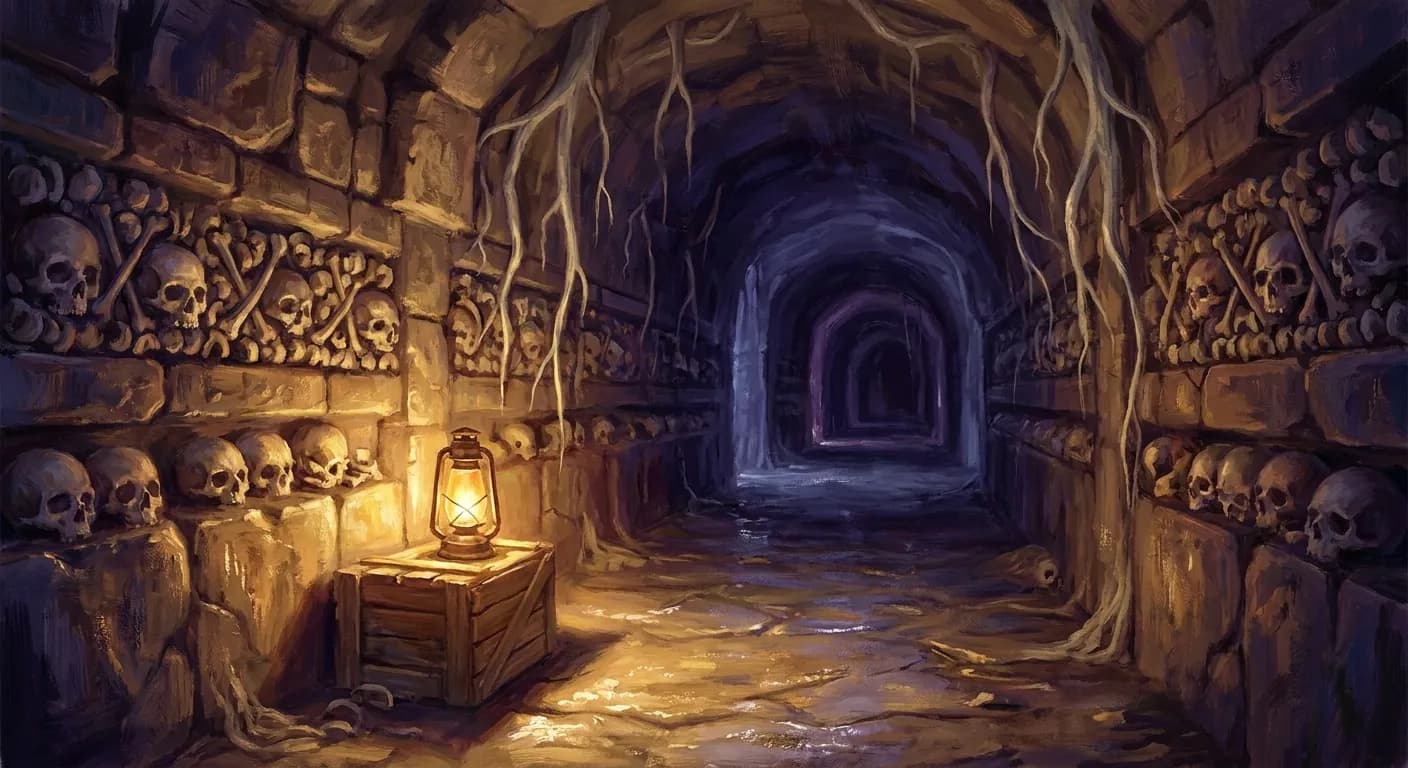
At first, the bones were simply dumped. Mountains of femurs and skulls in chaotic heaps, the democratic rubble of centuries. But beginning in 1810, an Inspector General of Quarries named Louis-Étienne Héricart de Thury transformed the chaos into something unprecedented. He ordered the remains stacked into hagues—retaining walls of bone—with tibias and skulls alternating in deliberate, almost decorative patterns. He placed ominous philosophical inscriptions above the doorways. He drilled the first geological well in Paris, creating the Bain de Pieds des Carriers (the Quarryman's Footbath), a pool of groundwater so clear that visitors frequently stepped into it before realizing it was there.iii Héricart de Thury wasn't just solving a logistical problem. He was curating an experience. The catacombs opened to visitors by appointment in 1809, complete with a guest register—arguably the birth of modern dark tourism.
The early VIP visitors tell us something about how the powerful have always been drawn to proximity with death, provided that proximity is theatrical enough. The Count of Artois—the future Charles X—brought a group of court ladies down in 1787. Francis I of Austria toured them in 1814. Meanwhile, somewhere in those same tunnels, mixed anonymously into the decorative walls of bone, lay the remains of Madame du Barry, the chemist Antoine Lavoisier, the assassin Charlotte Corday, and Maximilien Robespierre's sister. Revolutionaries and their victims, aristocrats and paupers, all rendered equal by the democracy of the ossuary. And then there is the story of François Décure, known as Beauséjour—a discharged soldier and quarry worker who, between 1777 and 1782, spent his break times chiseling an intricate scale model of the fortress of Port-Mahon into the limestone walls. He had been held captive there by the English, and he carved his prison from memory, underground, in the dark. He was killed by a cave-in while building a staircase to his own artwork.iv I can't stop thinking about that. A man who survived imprisonment only to die trying to make his suffering beautiful.
The Stench of Progress
London's burial crisis arrived slightly later and with a distinctly Victorian flavor—which is to say, it was marked by righteous reformers, horrifying pamphlets, and science that was heroically wrong. By the early nineteenth century, London's population was surging, and the city's churchyards were catastrophically overcrowded. Older bodies were routinely dismembered and scattered to make room for new ones. The ground in some burial yards had risen several feet above street level, bloated with centuries of remains.
Enter George Alfred Walker, a surgeon working in the slums of Drury Lane, who earned the nickname “Graveyard Walker” for his obsessive documentation of the crisis. His 1839 pamphlet Gatherings from Graveyards is one of the most viscerally disturbing public health documents ever written. Walker reported instances where gravediggers dropped dead instantly upon striking their spades into the soil, releasing concentrated toxic gases from the decomposing masses below.v Edwin Chadwick, the great sanitary reformer, published his own damning report in 1843. Both men were certain they had identified the mechanism of disease: miasma, the putrefying stench rising from the graves, was poisoning the air and causing cholera.
They were wrong about the science. Magnificently, consequentially wrong. Miasma didn't spread disease. The real killer was waterborne: pathogens like Vibrio cholerae leaching from cadavers into the groundwater and shallow wells that Londoners drank from. The liquid runoff from massive concentrations of decomposing bodies—what modern soil scientists call necro-leachate—contains biogenic amines, specifically cadaverine and putrescine, the breakdown products of the amino acids lysine and ornithine.vi The dead were indeed poisoning the living, just not through the air. There is something almost poetic about this error: Walker and Chadwick followed their noses to the right conclusion via the wrong path. The stench was a symptom, not a cause, but it led to real reform all the same.
The result was the 1832 Parliamentary act encouraging private, suburban “garden cemeteries”—the so-called Magnificent Seven: Kensal Green (1832), West Norwood (1836), Highgate (1839), Abney Park (1840), Nunhead (1840), Brompton (1840), and Tower Hamlets (1841). The Burial Act of 1852 then officially banned burials within London's inner limits.vii Highgate's Egyptian Avenue catacombs, built into a hillside to utilize natural cooling, capitalized on Victorian obsessions with Egyptology and the Gothic. These were not just practical solutions; they were ideological statements. Death was being expelled from the center of civic life and pushed to the periphery—literally to the suburbs. We are still living with the consequences of that expulsion.
The Skull That Sweats, the Skull That Takes Revenge
If Paris rationalized its dead and London sanitized them, Naples did something far more interesting: it befriended them. The Fontanelle Cemetery is a vast ossuary carved into the tuff rock of the Materdei quarter, holding roughly 40,000 remains—many of them victims of the 1656 plague, which killed half the city, and the 1836 cholera epidemic.viii But what makes Fontanelle extraordinary is not the dead themselves. It is what the living did with them.
The cult of the anime pezzentelle—the “beggarly souls”—was a Neapolitan practice in which ordinary people, mostly older women, would adopt an anonymous skull. They called these skulls capuzzelle. The adopter would polish the skull, give it a name (revealed to them in a dream), place it in a small wooden box, and pray for it. The theology, such as it was, held that these were souls trapped in Purgatory, too poor and forgotten to receive the prayers that would release them. In exchange for devotion, the soul was expected to grant favors—or, with striking pragmatism, provide winning lottery numbers from the afterlife. Devotees cleaned the skulls with alcohol. They inserted folded pieces of paper inscribed with prayers directly into the skulls' eye sockets.
There is a skull in Fontanelle known as the teschio che suda—the sweating skull. The condensation that gathers on its surface is interpreted by believers as evidence of the soul's ongoing purgatorial suffering. Another skull, Donna Margherita, is kept in a glass case with her jaw gaping open; local legend holds that she choked to death on a plate of gnocchi. And then there is the story of Il Capitano, the cemetery's most famous myth: a young Camorrista allegedly desecrated the site, and the Captain's skull threatened him. Mocking the skull, the man invited it to his future wedding. Years later, a man dressed in black appeared at the wedding and killed the newlyweds.ix
In 1969, Cardinal Ursi officially banned the cult as un-Christian and macabre. The devotees continued in secret. This is the detail that moves me most. Not the skulls, not the lottery numbers, not the revenge myths—but the fact that people kept coming back in defiance of their own church because the relationship felt real to them. There is something profoundly human in the refusal to let the anonymous dead remain anonymous. The Enlightenment impulse was to organize the dead, categorize them, push them to the margins. Naples chose instead to name them, talk to them, and ask them for help. I'm not sure which approach is stranger. I'm not sure which is more honest.
The Body Snatchers and the Architecture of Fear
Edinburgh in the 1820s was Europe's premier center for anatomical study, and it had a problem that no one wanted to discuss publicly. Scottish law strictly limited the bodies available for dissection to those of executed criminals, orphans, or suicides. But the demand for cadavers from medical schools vastly outstripped this legal supply. The result was an underground economy of “resurrection men”—grave robbers who exhumed fresh corpses under cover of night and sold them to anatomists. And the result of that was an extraordinary paranoid architecture: mortsafes (heavy iron cages locked over graves) and tall stone watchtowers where armed relatives stood guard over the recently buried.
William Burke and William Hare saw an opportunity to streamline the process. Between 1827 and 1828, these two Irish immigrants murdered at least sixteen people in Edinburgh's West Port neighborhood and sold their bodies to anatomist Dr. Robert Knox. The crucial and often-misunderstood fact about Burke and Hare is this: they were not grave robbers. They never robbed a single grave.x They bypassed the entire gruesome logistics of exhumation by creating fresh corpses. They were, in the most horrific sense, innovators. Hare originally got the idea when a fellow lodger died owing him rent; to recoup the debt, he and Burke sold the man's body to Dr. Knox. From there, the logic was grimly economic: why dig up a body when you can produce one?
They were caught in 1828 when lodgers found a body hidden under a bed. Hare turned King's Evidence and escaped prosecution. Burke was hanged on January 28, 1829. And then, in a symmetry that feels almost too neat for history, Burke's body was publicly dissected—the very fate he had facilitated for his victims. His skeleton remains on display at the Anatomical Museum of Edinburgh Medical School to this day. But the true legacy of Burke and Hare is legislative: their murders helped spur the passage of the Anatomy Act of 1832, which dramatically expanded the legal supply of cadavers for medical study. The dead, once again, reshaped the world of the living. A serial killing spree became a public health reform. Two murderers, through the perverse logic of history, advanced the cause of medicine.
Standing with the Dead in Palermo
The Capuchin Catacombs of Palermo take the relationship between living and dead to its most literal, most confrontational extreme. Here, roughly 8,000 mummified corpses are not hidden in walls of anonymous bone or tucked into ossuaries. They are propped upright in niches, dressed in their finest clothes, sorted meticulously by sex, age, and profession—priests in one corridor, soldiers in another, virgins in another still. Relatives would visit them, stand beside them, hold their hands.xi
The mummification process itself was exacting. The Capuchin monks placed bodies on ceramic pipe racks in dedicated preparation rooms to drain bodily fluids for up to a year. The corpses were then washed with vinegar and stuffed with straw or tow to maintain their shape before being dressed and mounted. Originally, this was a privilege reserved for the friars themselves, but over time it became a status symbol for Palermo's elite—a way of persisting, of refusing to disappear into the anonymous earth.
The most famous resident is Rosalia Lombardo, a two-year-old girl who died of pneumonia in 1920. Known as “Sleeping Beauty,” she is so well preserved that she appears to be merely napping. She was embalmed by Alfredo Salafia, a master taxidermist who used a formula including zinc salts, formalin, salicylic acid, and glycerin—a recipe that was lost after his death and only recently rediscovered.xii Today, bioarchaeologists like Dr. Dario Piombino-Mascali are using non-invasive radiography to study 41 unnamed mummified children in the catacombs, extracting data about childhood nutrition, health, and trauma in eighteenth- and nineteenth-century Sicily. The morbid curiosity of one era becomes the ethical research methodology of the next. The children who were displayed as spectacle can now, perhaps, tell their own stories.
The Chemistry of Refusal
There is a chemical dimension to all of this that rarely gets discussed but that I find grimly fascinating. When too many bodies are buried in waterlogged, anaerobic soil—which is to say, in the overcrowded churchyards of every major European city—human fat undergoes hydrolysis and saponification, producing a waxy substance called adipocere, sometimes called “grave wax.” Adipocere halts decomposition. It preserves soft tissue for years or decades, which means the dead don't make room for more dead. The overcrowding compounds itself. The crisis is self-reinforcing: pack too many bodies together and chemistry itself conspires to keep them intact, to refuse the tidy cycle of dust to dust.
I find something almost philosophical in this. We tell ourselves that death is an ending, that the body returns to the earth, that nature reclaims what we borrow. But the chemistry tells a different story. Under the right conditions—or rather, the wrong ones—the body resists. It turns to wax. It poisons the water with cadaverine and putrescine. It collapses basement walls. The dead do not go quietly. They persist, in ways that are chemical and physical and, if the Neapolitans are right, perhaps spiritual too.
The expulsion of the dead to the suburban ring—Paris's catacombs, London's Magnificent Seven, the garden cemeteries that spread across Europe and eventually America—initiated one of the most profound psychological shifts in modern history. Death was removed from the daily, communal center of city life. The local parish churchyard, where you walked past your grandparents' graves on the way to buy bread, was replaced by a distant, parklike space you visited by appointment. The dead became something you drove to see, not something you lived among. We call this progress. We call it public health. We call it urban planning. But it is also, unmistakably, a kind of forgetting.
What the Dead Built
I have never smelled adipocere, or stepped by accident into the Quarryman's Footbath. What draws me down here anyway is the way these spaces reveal the constant negotiation between the living and the dead, a negotiation that shaped the physical infrastructure of modern cities in ways we've collectively agreed to ignore.
Public health reform, the garden cemetery movement, the Anatomy Act, the entire modern funeral industry, the suburban sprawl that defines how we build our cities, the sanitary engineering that keeps our water clean—all of these trace their origins, in part, to the crisis of too many bodies in too little ground. Haussmann's Paris, with its wide boulevards and rational geometry, was built on a labyrinth of bone. London's green belt, its parklands and suburban railways, owes a debt to the cholera-ridden churchyards that made the inner city uninhabitable. Edinburgh's medical schools, among the finest in the world, were fueled by murder. The underground shaped the surface. It always does.
And here is what I keep returning to, the question I can't resolve: was the banishment of the dead from daily life a triumph or a loss? The Neapolitan women who polished their adopted skulls and tucked prayers into the eye sockets—they lived in intimate communion with mortality. They knew the dead by name, even if they had to invent those names. They negotiated with death as a neighbor, not an abstraction. We, by contrast, have built a civilization premised on the dead staying where we put them: out of sight, out of the water supply, out of the basement. We are healthier for it. We are safer. But I wonder sometimes if we are also more afraid—if the great modern terror of death comes precisely from having pushed it so far away that we no longer recognize it when it arrives. The subterranean cities are still down there, beneath the cafés and the Metro stations and the elegant apartments. Six million bones in Paris alone. They are the foundation we pretend doesn't exist, the architecture of everything we built to escape them.
Sources & Further Reading
- i.The Good Life France, on visiting the Paris Catacombs
- ii.Wikipedia: Catacombs of Paris — history and origins
- iii.Les Catacombes de Paris, official site of the City of Paris
- iv.Mainly Museums, on the ossuary galleries of the Paris Catacombs
- v.George Alfred Walker, Gatherings from Graveyards (1839), on the Victorian burial crisis
- vi.Soil-chemistry literature on necro-leachate migration from burial grounds
- vii.Wikipedia: the Magnificent Seven cemeteries of London
- viii.Wikipedia: Fontanelle cemetery, Naples
- ix.Neapolitan folklore of the anime pezzentelle and the adopted skulls of the Fontanelle
- x.Wikipedia: the Burke and Hare murders and the Edinburgh anatomy trade
- xi.Wikipedia: Capuchin Catacombs of Palermo
- xii.Wikipedia: Rosalia Lombardo and Alfredo Salafia's embalming formula
A new exploration goes up most days. Nothing to sign up for.