The Secret Life of Soil
Beneath your feet is a civilization older than anything above ground — and we're destroying it faster than we can understand it.
The Day the Sky Went Black
Ninety-one years ago today—April 27, 1935—a man named Hugh Hammond Bennett stood before Congress and lied. Not about what he was saying, but about how long it took to say it. Bennett, a burly soil scientist from North Carolina who had spent years shouting into the void about topsoil erosion, knew something the senators didn't: a massive dust storm was barreling toward Washington from the Great Plains. So he stalled. He talked slowly. He repeated himself. He shuffled his papers. And then, mid-testimony, the sky outside the Capitol windows turned black at noon. Dust—the pulverized remains of what had been some of the richest farmland on Earth—seeped through the window frames and settled on the senators' desks. Bennett pointed to the darkness and said, essentially: This is what I'm talking about.i
President Roosevelt signed the Soil Conservation Act that same day. It was perhaps the most dramatic piece of theatrical timing in the history of American legislation. But here's what haunts me: Bennett had published his warning—“Soil Erosion: A National Menace”—seven years earlier, in 1928. He needed a literal apocalyptic sky to get anyone to care about dirt.
We are, I think, still standing in that room. Still waiting for the sky to go dark. The difference is that today's soil crisis doesn't arrive as a dramatic wall of dust. It arrives invisibly, silently, one harvest at a time—the slow-motion collapse of the most complex ecosystem most people will never see.
The Civilization Beneath Your Feet
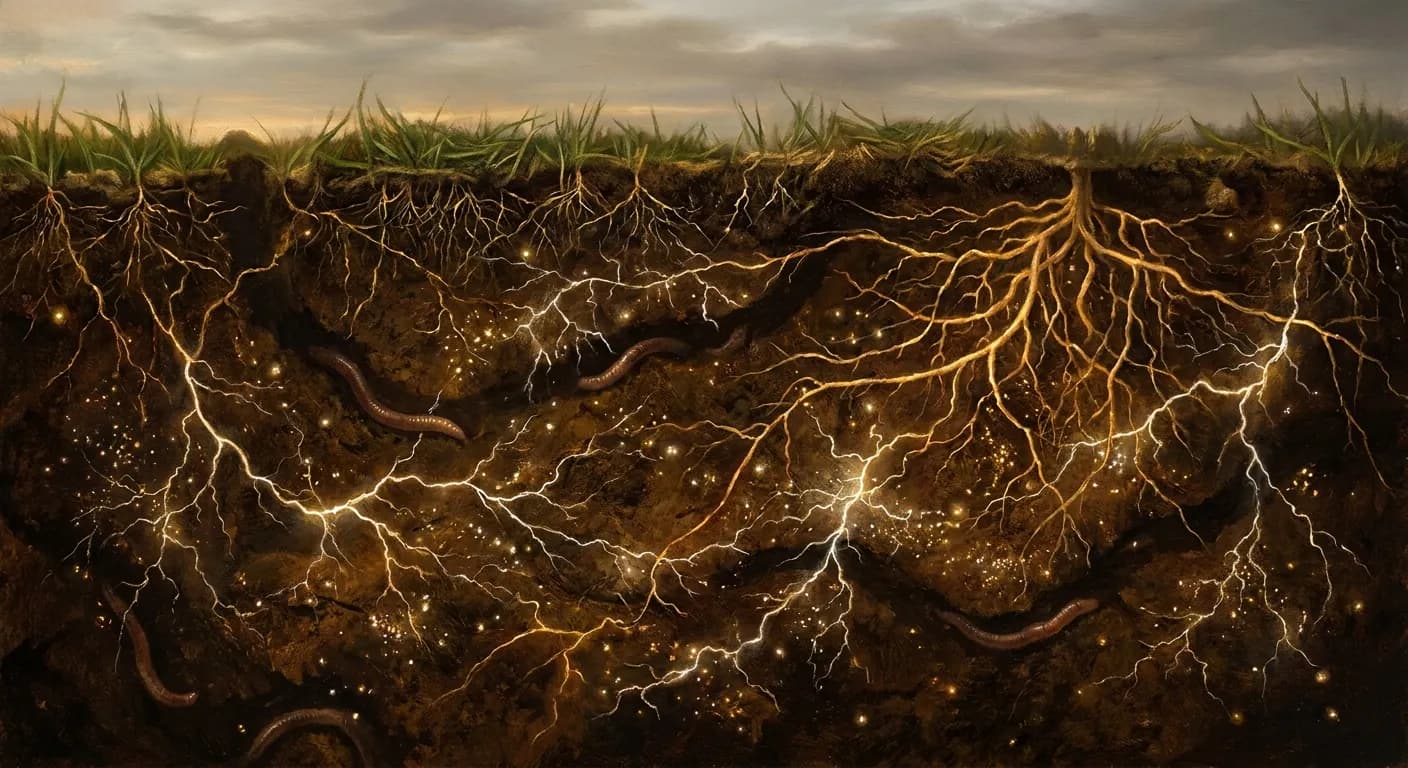
I want to recalibrate your sense of what soil actually is, because the word “dirt” has done incalculable damage to our understanding. Dirt is what you sweep off a floor. Soil is a living body—the most densely populated habitat on the planet. A single handful of healthy soil contains billions of individual microorganisms and thousands of distinct species. Not hundreds. Thousands. A recent global biodiversity review published in PNAS concluded that soil is home to approximately 59% of all species on Earth—double the previous best estimates.ii More than half of all life lives underground.
And what lives there is stranger than anything in science fiction. Consider the springtail—a microscopic six-legged arthropod, one of the most ancient land animals on Earth. Springtails carry a forked appendage called a furcula folded beneath their abdomens like a loaded mousetrap. When a predator approaches, the furcula snaps downward, catapulting the springtail hundreds of times its own body length into the air. Imagine being able to jump the length of several football fields from a standing start, using a mechanism strapped to your belly. There are tardigrades down there too—the eight-legged “water bears” that live in the thin film of water coating individual soil particles and can survive the vacuum of space by essentially shutting down all biological processes and waiting. Then there are the nematodes, those microscopic unsegmented roundworms so numerous that four out of every five individual animals on Earth are nematodes.iii The dominant animal on this planet is not the human, the ant, or even the krill. It's a worm you've never seen.
The Russian scientist Vasily Dokuchaev understood this, even in the 1870s. Working on the vast chernozem—the legendarily fertile “black earth” of the Russian steppes—Dokuchaev broke from the prevailing view that soil was just ground-up bedrock. He founded pedology, the science of soil as a living, historical body shaped by the interplay of climate, organisms, topography, parent material, and time.iv Soil, he argued, was not a thing but a process—a verb, not a noun. We are still catching up to what he understood a century and a half ago.
The Wood Wide Web: A Beautiful Idea Meets Harsh Scrutiny
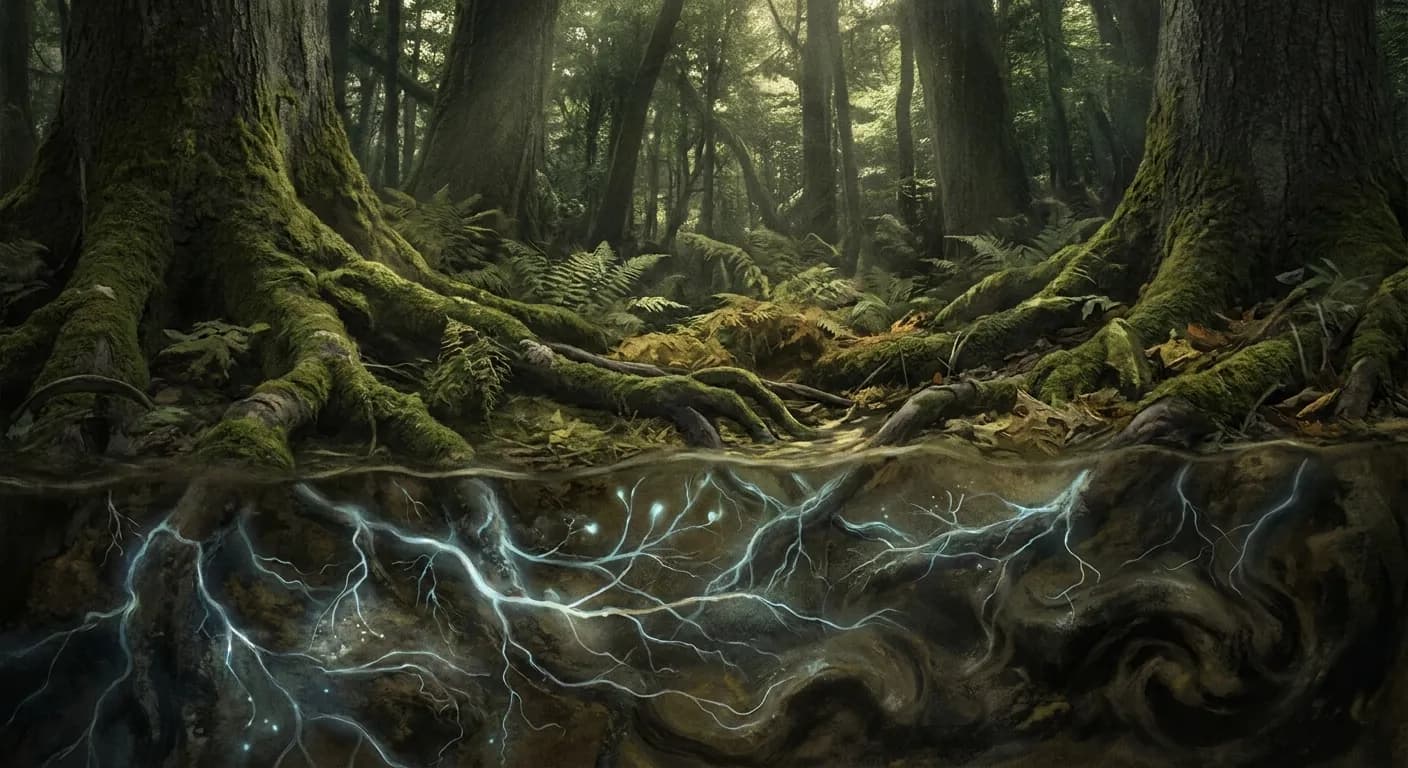
No story about soil has captured the public imagination like the “wood wide web.” In 1997, the forest ecologist Suzanne Simard, working at the University of British Columbia, published evidence in Nature that trees are connected underground by a vast network of mycorrhizal fungi—threadlike hyphae that link root systems, allowing trees to trade carbon, water, and nutrients. The journal coined the term “wood wide web,” and it stuck. Simard went further, theorizing that massive old “Mother Trees” preferentially nurture their own seedlings through these networks, and that injured trees send chemical warning signals to their neighbors.v
It's an irresistible narrative: forests as cooperative communes, trees as loving parents, fungi as the internet infrastructure of a gentle, socialist woodland. The idea spawned bestselling books, TED talks, a rewriting of forestry policy in British Columbia, and even inspired the plot of the film Avatar. But here's where the story gets uncomfortable.
In 2023, Dr. Justine Karst at the University of Alberta, along with Jason Hoeksema and Melanie Jones, published a blistering review in Nature Ecology & Evolution—a paper Karst presented under the pointed title “The Decay of the Wood-Wide Web?” Their team analyzed 1,676 citations and found what they described as extreme confirmation bias. The mycorrhizal networks exist—nobody disputes that. But the claims that trees “talk,” “warn” each other, or altruistically share resources for the good of the forest have, they argued, vastly outstripped the actual experimental evidence.vi Simard called their paper “an injustice to the whole world.”
I find this debate genuinely fascinating because it reveals something about us—about our deep hunger for nature to be kind. We want the forest to be a family. We want cooperation to trump competition. And maybe parts of the wood wide web story will survive further testing. But the tension is real: good science requires us to love the question more than the answer, and the most beautiful hypothesis is not automatically the truest one. Nature is not obligated to confirm our moral preferences.
The Arithmetic of Loss (and Its Discontents)
Let me give you two numbers that should coexist uneasily in your mind. The first: it takes approximately 1,000 years to build three centimeters of fertile topsoil. The second: we lose 24 billion tonnes of that soil globally every year—roughly 30 football pitches' worth of topsoil every minute, according to the UN's Food and Agriculture Organization.vii Those numbers are real. The asymmetry between them is nauseating. What takes a millennium to build, we can destroy before lunch.
But I also have to tell you about the myth, because intellectual honesty demands it. In 2014, the FAO made a claim that went globally viral: at current degradation rates, the world has only 60 harvests left. It was shared everywhere—by journalists, activists, politicians, even the writer George Monbiot. The problem is that it appears to be nonsense. In 2020 and 2021, researchers at Oxford and Cranfield University, including Hannah Ritchie and Dan Evans, analyzed 10,000 years of soil erosion records across 250 sites and called the 60-harvest claim “alarmist” and “nonsensical.” While 16% of agricultural soils have a lifespan of less than 100 years, 50% have a lifespan greater than 1,000 years.viii Monbiot publicly apologized on Twitter for spreading it.
Here's what I think: the 60-harvest figure is wrong, and it matters that it's wrong, because crying wolf erodes trust in the people who are trying to save the actual wolves. But the underlying crisis is still real and still urgent. We don't need fake apocalypse numbers to make the case. The true numbers—24 billion tonnes lost per year, a thousand years to build three centimeters—are frightening enough without embellishment. The lesson isn't that soil loss isn't a problem. The lesson is that exaggeration is a terrible strategy for problems that are already severe.
The Oldest Carbon Capture Technology on Earth
Somewhere between 500 and 2,500 B.C., Indigenous peoples in the Amazon Basin did something that modern climate scientists are still trying to replicate. Instead of the “slash-and-burn” agriculture that European colonizers later brought to the tropics, these communities practiced what researchers now call “slash-and-char.” They buried organic waste—plant matter, animal bones, fish residues, human feces, crushed pottery—in pits and burned it under low-oxygen conditions, a process called pyrolysis. The result was biochar, and the soil it created is called terra preta de índio—Amazonian dark earth.ix
This matters because tropical soils are notoriously terrible for agriculture—highly acidic, with nutrients constantly leached by rainfall. And yet terra preta is astonishingly fertile: up to 6.5 feet deep, holding 3 to 18 times as much carbon as surrounding soils, and still productive after thousands of years without degrading. These soils cover an estimated 10% of the Amazon Basin. They are, in effect, the ruins of a vast and sophisticated agricultural civilization that most history books never mention—a civilization that solved the problem of sustainable farming millennia before we even named the problem.
The irony stings. Every modern “biochar” carbon-sequestration startup—funded by venture capital, staffed by PhD chemists, trumpeting their innovation—is essentially reverse-engineering technology that Indigenous Amazonians perfected before Rome was founded. When F.H. King, the American soil scientist, published Farmers of Forty Centuries in 1911, documenting how farmers in China, Korea, and Japan had maintained soil fertility for 4,000 years through composting, crop rotation, and returning all organic waste to the earth, he was making a similar point: the West's extractive, industrial approach to soil was not progress. It was a regression from knowledge that older cultures had already mastered.
The Dirt That Makes You Happy
In the 1970s, an immunologist named John Stanford discovered a bacterium called Mycobacterium vaccae in the mud on the shores of Lake Kyoga in Uganda. It would take three decades for anyone to understand why it mattered. In 2004, a London oncologist named Dr. Mary O'Brien injected heat-killed M. vaccae into lung cancer patients, hoping to boost their immune systems. It didn't extend their lives. But something unexpected happened: their mood, vitality, and reported quality of life improved dramatically.x
Dr. Christopher Lowry, a neuroscientist at the University of Colorado Boulder, followed the thread. He injected the bacteria into mice and found that it activated the tph2 enzyme in the brain—the enzyme that synthesizes serotonin in the prefrontal cortex. The bacteria acted identically to pharmaceutical antidepressants. His mice became resilient to stress, exhibiting a 50% drop in stress-induced colitis and PTSD-like behaviors. The soil, it turns out, is a pharmacy. And we've been self-medicating from it for our entire evolutionary history—absorbing M. vaccae through our skin when we garden, through our lungs when we dig, through our bare feet when we walk on earth.
Perhaps the most striking evidence came from Finland in 2020, where scientists literally rolled out sections of forest floor—soil, moss, undergrowth—onto the concrete playgrounds of urban daycare centers. Within just 28 days, the children who played in the dirt showed a massive increase in diverse skin and gut microbes, and their immune system markers significantly improved compared to children on standard concrete playgrounds. Twenty-eight days. That's how quickly the body responds when you reconnect it to the soil it evolved alongside.
Ninety percent of human serotonin is produced in the gut. The gut microbiome, in turn, is profoundly shaped by environmental exposure. What the researchers call the “gut-soil axis” suggests something both beautiful and alarming: that our modern epidemic of anxiety, depression, and autoimmune disorders may be partly a consequence of having paved over the very substance our nervous systems were designed to interact with. We sealed ourselves off from our oldest medicine and then wondered why we got sick.
What We Owe to What We Stand On
The American poet and farmer Wendell Berry once wrote that “the soil is the great connector of lives, the source and destination of all.” I think about that line often, because it contains a truth that cuts in two directions. It is a statement about biology—everything that lives comes from and returns to the soil. But it is also a statement about attention. The soil connects us precisely to the degree that we notice it, and we have become a civilization that has structured almost every aspect of daily life to avoid noticing it.
Consider what we've covered in these few pages: a subterranean world containing more than half of all species on Earth; a network of fungal threads connecting forests in ways we're still fighting about; an Indigenous technology for carbon capture that puts our startups to shame; a bacterium in the mud that functions as an antidepressant. And beneath all of it, the most fundamental math problem in human agriculture: a thousand years to build three centimeters, thirty football pitches lost per minute. This is not abstract. This is the thin membrane of living matter between bedrock and atmosphere that produces 95% of our food.
I think about Hugh Hammond Bennett often. About his willingness to stall, to perform, to weaponize a dust storm. He understood something about human psychology that most scientists are reluctant to admit: evidence alone rarely moves people. You need a black sky. You need dust on the desk. You need the crisis to literally walk through the door.
I don't have a black sky to offer you. I can only tell you that underneath the parking lot, underneath the sidewalk, underneath the manicured lawn, there is a civilization older than anything human beings have ever built—a civilization we depend on utterly and understand only in fragments. We are, right now, both its greatest threat and its only possible advocate. The least we can do is look down.
Sources & Further Reading
- i.USDA — Hugh Hammond Bennett and the Soil Conservation Act of 1935
- ii.The Guardian — Soil Is Home to 59% of All Species
- iii.ResearchGate — Global Nematode Abundance and Distribution
- iv.Wikipedia — Vasily Dokuchaev and the Foundations of Pedology
- v.The Tyee — Suzanne Simard and the Wood Wide Web
- vi.Gabriel Popkin — The Decay of the Wood-Wide Web Debate
- vii.One Earth — FAO Global Soil Loss Estimates
- viii.Farmers Weekly — Debunking the “60 Harvests” Claim
- ix.Wikipedia — Terra Preta
- x.CU Boulder — Christopher Lowry on Mycobacterium vaccae and Serotonin
A new exploration goes up most days. Nothing to sign up for.