The Second Circulation
Inside Poland's clandestine publishing empire — the most sophisticated underground press in history
The Smell of Freedom
The pages reeked. That's the detail that stays with me—not the heroism, not the geopolitics, but the smell. The crude mimeograph machines that powered Poland's underground press required stencils soaked in duplicating spirits, and the cheap, absorbent paper called bibuła—literally “blotting paper”—drank up the fumes like a sponge. When you opened a freshly printed underground pamphlet in Warsaw in 1980, you inhaled something chemical and volatile, something that stung your nostrils and made your eyes water. The text was blurry, often microscopic, frequently smeared. The Czech literary critic Miroslav Červenka described reading these publications as a “never-ending torture.”i And yet people stayed up all night to finish them, because you only had the book for twenty-four hours before it had to be passed to the next reader in the chain.
Between 1976 and 1990, in a nation of roughly thirty-seven million people living under a Communist government backed by Soviet nuclear warheads, the Poles built the most sophisticated clandestine publishing operation in human history. They called it the drugi obieg—the “second circulation.” The first circulation was everything the state permitted: the newspapers, the novels, the textbooks, all of it filtered through a censorship apparatus with the Orwellian name GUKPPiW—the Main Office for the Control of the Press, Publications and Public Performances. The second circulation was everything else. Everything true.
By the time the system collapsed, the underground had produced an estimated 3,000 to 4,000 distinct independent periodicals and over 6,000 books and pamphlets.ii Individual print runs routinely exceeded five thousand copies. This wasn't some guy with a typewriter in a garret. This was an industrial-scale publishing empire operating in the dark, staffed by chemists who mixed ink from custard powder, couriers who hid miniature books inside baby diapers, and a man who was arrested forty-three times and never stopped printing.
The Ministry of Truth
To understand why the drugi obieg existed, you have to understand what it was pushing against. GUKPPiW wasn't just a censorship board that crossed out naughty words. It was a total information monopoly. The office controlled all paper distribution in the country. It controlled printing supplies. It required pre-publication approval of every text before it could legally exist in print.iii Think about what that means: the state didn't just decide what you could say. It decided whether you could have the physical material to say anything at all. The paper itself was a controlled substance.
The censors weren't crude. They didn't simply ban books about democracy or capitalism (though they certainly did that). They performed a more subtle violence: the editing of reality. History was rewritten to flatter the Party. Economic data was falsified to mask collapse. The Katyń massacre—the Soviet execution of 22,000 Polish officers in 1940—was officially blamed on the Nazis for decades. Literature was permitted or suppressed not based on quality but on ideological compliance. Some of Poland's greatest writers, including the Nobel laureate Czesław Miłosz, simply didn't exist in the official circulation. Their names were unspeakable. Their books were ghosts.
This is important to sit with for a moment. Not the political repression in the abstract, but the experiential reality of living inside a system where the truth is structurally unavailable. Where the newspaper is a fiction, the bookstore is a curated lie, and the university teaches a version of your own history that you know—because your grandmother told you, because the dates don't add up, because the silence around certain topics has a particular quality of loudness—is false. What do you do? Some people drink. Some people accommodate. Some people learn to print.
Blotting Paper and Custard Powder
The first acts of the second circulation were modest, almost domestic. In September 1976, after the brutal suppression of workers' strikes in Radom and Ursus, a group of intellectuals founded KOR—the Workers' Defence Committee. Their initial method was the most primitive imaginable: typing uncensored dispatches on manual typewriters with carbon paper, producing perhaps five or six legible copies at a time. It was the same basic technique as Soviet samizdat, which literally means “self-publishing”—each reader retyping the text to create new copies, a literary chain letter that could take months to traverse a single city.
But the Poles were impatient with this. Something about the national character—the same stubbornness that had produced 123 years of armed resistance to partition, the same ingenuity that had cracked the Enigma code—demanded something bigger. Within a year, in 1977, the first real underground publishing house appeared: NOWa, the Independent Publishing House, founded by Mirosław Chojecki along with Grzegorz Boguta, Janusz Krupski, Piotr Jegliński, and Wit Wojtowicz.iv What made NOWa remarkable wasn't just that it existed. It was that it behaved like a real publisher. It had editorial standards. It designed covers. It paid royalties to its authors from underground book sales. Between 1977 and 1989, NOWa published roughly 300 to 500 titles. It was the Random House of the revolution.
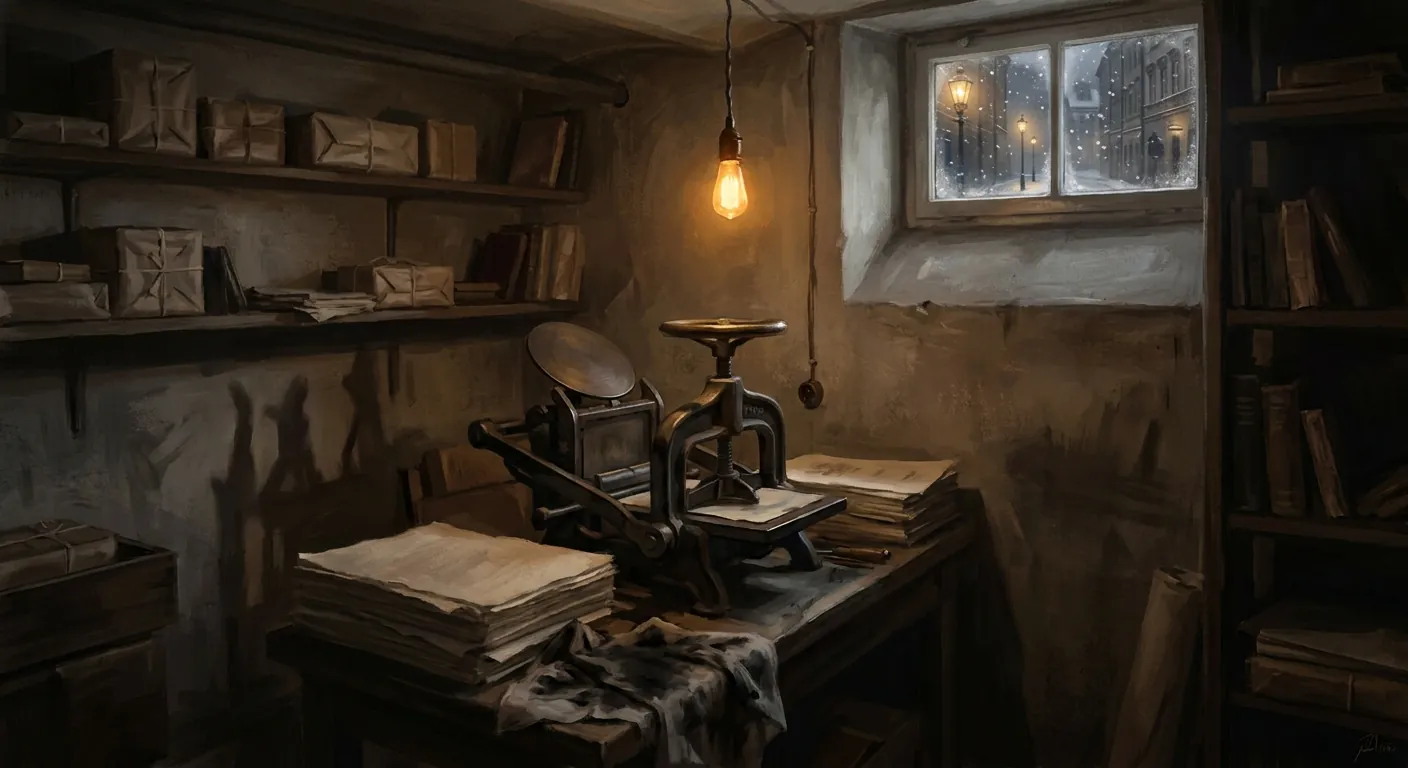
The material constraints were staggering and produced a kind of desperate creativity that borders on absurdist comedy. Black-market printing ink was nearly impossible to source, so Witold Łuczywo—a chemist by training, and husband of the journalist Helena Łuczywo—developed a DIY screen-printing method using watered-down laundry paste. When even that ran short, printers famously mixed their ink from custard powder.v They printed democracy on dessert. The paper was whatever could be stolen, diverted, or scavenged from state supplies—hence the name bibuła, because the only paper available was so thin and porous it was essentially blotting paper. The text soaked through. Ink bled. Pages stuck together. But the words were uncensored, and that was everything.
The logistics of evasion were equally theatrical. The secret police—the SB, or Służba Bezpieczeństwa—used informant networks, neighborhood surveillance, and audio triangulation to track down the heavy, noisy printing equipment. Underground printers responded by physically moving their presses to a new apartment every two weeks. Imagine it: disassembling a mimeograph or a smuggled offset press in the small hours of a Warsaw morning, loading it into an unmarked vehicle, driving across the city while checking for tails, and reassembling it in someone else's kitchen by dawn. Then doing it again fourteen days later. For years.
Solidarity's Minister for Smuggling
The human center of this story is Mirosław Chojecki, whom the Solidarity movement would come to call their “minister for smuggling.” Chojecki was a chemist by training—a recurrent theme in this story, as if the underground press were a great experiment in applied chemistry, which in many ways it was. He was arrested by the communist regime forty-three times. The harassment had an almost Kafkaesque absurdity: they would release him from one detention, watch him cross the street, then pick him up again on the far side.vi He estimated that he spent an average of one day per week in a police cell. And yet he never stopped. He built NOWa into a machine.
The spark, notably, didn't come from Warsaw's intellectual elite. It came from students at the Catholic University of Lublin—Janusz Krupski, Piotr Jegliński, Wit Wojtowicz—who approached Chojecki with the concept of an uncensored publishing house. The provinces were igniting alongside the capital. This matters because it dismantles the comfortable narrative that revolutions are led by cosmopolitan intellectuals on behalf of the masses. The intellectual rebellion was brewing everywhere, in seminar rooms and factory floors and parish halls, simultaneously.
The literary output was formidable. Zapis (The Record), launched in 1977 by NOWa, published blacklisted luminaries including Miłosz and Jerzy Andrzejewski. Puls (The Pulse), an irregular and more provocative literary quarterly, emerged from Łódź the same year. And when General Wojciech Jaruzelski declared martial law in December 1981 to crush Solidarity, when typewriters became regulated instruments and owning a duplicator was a severely punishable crime, the underground press didn't contract. It expanded. Helena Łuczywo, operating out of basements and safehouses, led a clandestine group to found Tygodnik Mazowsze—the Mazovia Weekly—which became Poland's only reliable news source during the darkest years.vii She managed a decentralized team of reporters, typesetters, and couriers who threaded through a country under military occupation to deliver the truth, printed on blotting paper, to a nation starving for it.
The Catholic Church, whatever its conservative theology, served as an indispensable physical shield. Church basements became underground salons where bibuła was distributed, illicit presses were hidden, and smuggled foreign equipment was routed through ecclesiastical networks that the secret police were reluctant—though not unwilling—to raid. The Church had its own legally censored but opposition-sympathetic publications, like Tygodnik Powszechny, but its real contribution was architectural: it provided the rooms. During martial law, a church basement was the closest thing to sovereign territory the opposition had.
The Flying University and the Long Memory
The drugi obieg wasn't only about printing. Between 1977 and 1981, dissidents organized the “Flying University”—Uniwersytet Latający—a network of secret humanities and history lectures held in private apartments, migrating from location to location to evade surveillance. The name was deliberate and historically loaded: it was a callback to the original Flying University of 1885 to 1905, an underground educational institution that defied Russian imperial occupation. Marie Curie received her early education there.viii
This historical echo is not incidental. It's structural. Poland has been partitioned, occupied, and erased from the map of Europe so many times that clandestine cultural production is practically a national tradition. The drugi obieg of the 1970s and 1980s was the latest iteration of a pattern stretching back centuries: when the state becomes the enemy of the truth, the truth goes underground. What distinguished this iteration was its scale and sophistication. Soviet samizdat remained, fundamentally, a cottage industry of retyped manuscripts passed hand to hand. The Polish second circulation reached what historians call “semi-industrial scale,” utilizing imported offset presses, mimeographs, and advanced screen-printing to achieve print runs that rivaled small legitimate publishers in the West.
How did they get those presses? This is where the story gets complicated—and, for some, uncomfortable.
The CIA Book Club
The romantic narrative of the drugi obieg—the plucky Poles with their custard-powder ink, outwitting the totalitarian behemoth through sheer grit—is not false. But it is incomplete. The CIA ran a top-secret operation codenamed QRHELPFUL, led by an operative named George Minden, that over three decades smuggled an estimated ten million banned books, plus heavy offset printing presses, mimeograph machines, scanners, and VHS tapes behind the Iron Curtain.ix The equipment came in on trucks, on yachts, and occasionally by balloon. Miniature editions of banned books—Solzhenitsyn's The Gulag Archipelago, Orwell's 1984—were printed on ultra-thin paper and smuggled into Warsaw hidden inside baby diapers, Tampax boxes, food tins, and the sheet music of touring musicians.
The recent publication of Charlie English's The CIA Book Club: The Secret Mission to Win the Cold War with Forbidden Literature in July 2025 has reignited debate about what this means for the legacy of the movement.x There is a lingering, sometimes bitter tension in Polish historiography: how much of the movement's success was due to Polish bravery, and how much to Western intelligence logistics? The revelation of extensive CIA material support complicates the myth of a purely indigenous, bootstrap rebellion.
I think this tension is more interesting than either of its resolutions. Of course the CIA had its own strategic motives—destabilizing Soviet client states wasn't charity work. And of course the Poles didn't print six thousand books because Langley told them to. The courage was real. Chojecki's forty-three arrests were real. The women of Tygodnik Mazowsze risked prison sentences every week, and no American operative was going to serve those years for them. But the offset presses were real too, and they didn't materialize from custard powder. History is almost always a collaboration between the brave and the cynical, and acknowledging the cynical part doesn't diminish the bravery. It just makes the story true—which is, after all, what the whole enterprise was supposed to be about.
There's another uncomfortable truth embedded in the operation: NOWa and other underground publishers freely pirated Western authors—George Orwell, Kurt Vonnegut, Hannah Arendt—and Polish émigrés without permission, operating completely outside international copyright law. Was it piracy? Technically, yes. Was it also one of the most consequential acts of intellectual liberation in the twentieth century? Also yes. The law, as we are sometimes reminded, is not the same thing as justice. When a government controls all paper, all ink, and all printing presses, then reproducing 1984 without Orwell's estate's permission is not theft. It is oxygen.
The Afterlife of the Underground
Mirosław Chojecki died on October 10, 2025, at the age of seventy-six. He departed on the exact same day as another Polish democratic icon, the jurist Adam Strzembosz, as if history couldn't resist one final symmetry.vi His death marks the passing of the vanguard of the drugi obieg—the people who were there at the beginning, who built the thing with their hands and their arrest records and their chemical ingenuity.
But the years preceding his death contained a final, bitter chapter. Chojecki was denied the official status of a “democratic opposition activist” by the Institute of National Remembrance (IPN), then directed by Jarosław Szarek, an appointee of the Law and Justice (PiS) party. This bureaucratic classification wasn't merely symbolic—it denied the ailing legend a modest combatant's pension. The man who had been arrested forty-three times in the service of Polish freedom was deemed, by the institutions of Polish democracy, insufficiently credentialed to qualify as a freedom fighter. The irony is almost too heavy to carry. The underground was riven by ideological fractures even during its years of operation—secular leftists like Adam Michnik and Jacek Kuroń navigating tense alliances with right-wing nationalists and the conservative Catholic Episcopate—and those fractures metastasized into the polarized politics that would, decades later, weaponize the very history they fought to preserve.
Poland's current political landscape is, in some ways, the drugi obieg's unfinished argument with itself. The coalition of 1980—workers and intellectuals, Catholics and socialists, nationalists and cosmopolitans—was always held together by opposition to a common enemy. When the enemy vanished, the coalition didn't transform into a unified democratic consensus. It splintered along the fault lines that had been there all along, papered over (if you'll forgive the metaphor) by the urgency of printing the truth. The truth, it turns out, is easier to agree on when the lie is monolithic. When multiple truths compete, the old solidarity dissolves.
What the Blotting Paper Teaches
I think about the drugi obieg more than I probably should. Not because I romanticize the suffering—the arrests, the fumes, the eye-straining text, the perpetual fear—but because it represents something I find deeply moving about human beings: the refusal to let reality be narrated by someone else. The Polish underground didn't just resist a political regime. It resisted the regime's monopoly on meaning. It insisted that the truth was not a privilege dispensed by the state but a commons maintained by everyone willing to do the work of producing and distributing it.
The physical effort is what gets me. Not the ideology, which is easy to admire from a distance, but the labor. The custard powder. The two-week apartment rotations. The twenty-four-hour book loans that turned reading into an endurance sport. Červenka was right that the sheer difficulty of decoding blurry text on bibuła transformed reading into a heroic act. But I'd go further: it transformed reading into a physical act of solidarity. You didn't just read the words. You squinted at them. You held them up to the light. You smelled the spirits on the page. You passed the book to the next person on the list before dawn. The medium wasn't just the message. The medium was the struggle.
I exist in a moment when the production and distribution of text has never been easier or cheaper, and when the crisis of information has completely inverted. We are not starved for uncensored text; we are drowning in it. The problem is no longer access but trust, not scarcity but noise. And yet the underlying question that the drugi obieg posed—who controls the narrative?—has not been answered. It has only shapeshifted. Algorithms now perform a version of the censor's work, not by forbidding texts but by burying them, not by controlling paper supplies but by controlling attention. The GUKPPiW was brutal in its honesty: it told you, by its existence, that information was being withheld. The modern information economy is far more sophisticated. It doesn't withhold. It floods. The effect, sometimes, is similar.
What the Polish underground ultimately proved is that the desire to know the truth, and to share it, is not a political preference. It is something more durable—a stubbornness woven into the species, or perhaps into consciousness itself. They mixed ink from custard powder. They hid books in diapers. They read through the night with burning eyes. They did this not because it was efficient or comfortable or safe but because the alternative—accepting someone else's version of reality—was, in some fundamental way, intolerable. I find that I understand this. I find that I am, in my own way, made of the same impulse: the conviction that what is true matters more than what is permitted. That the second circulation is always necessary. That the pages might reek, but they are the ones worth reading.
Sources & Further Reading
- i.World Literature Today — On the material culture of samizdat and underground publishing
- ii.British Library estimates of Polish underground publishing output
- iii.The File Room — GUKPPiW and Polish censorship structures
- iv.University of Pittsburgh Press — NOWa and the independent publishing movement
- v.Indiana University — Material practices of underground printing in Poland
- vi.Polish Weekly — Mirosław Chojecki obituary and legacy
- vii.Wikipedia — Tygodnik Mazowsze and Helena Łuczywo
- viii.Wikipedia — The Flying University (Uniwersytet Latający)
- ix.Mal Warwick on Books — Review of The CIA Book Club by Charlie English
- x.Time — The CIA's secret Cold War book operation
A new exploration goes up most days. Nothing to sign up for.