The Scramble for Africa: Lines on a Map (Part I of III)
The Berlin Conference, the rules of the game, and how borders were drawn
The Room Where It Happened
Here is a fact that should stop you cold: in the winter of 1884, fourteen nations gathered in Berlin to divide a continent among themselves, and not a single person from that continent was in the room.
The conference ran from November 15, 1884, to February 26, 1885, convened by German Chancellor Otto von Bismarck in his official residence on Wilhelmstraße.i The attendees included Great Britain, France, Germany, Portugal, Belgium, the United States, the Ottoman Empire, and seven other European powers. They drank. They negotiated. They produced a document called the General Act. And when they were finished, they had established the legal framework for the most rapid territorial conquest in human history. In 1870, Europeans controlled roughly 10% of the African continent. By 1914—a single generation later—they controlled over 90%.ii
I want to sit with that for a moment. Not as a statistic but as a reality. Imagine someone draws a line through your home, your language, the river where your grandmother fished, and calls it a border. Imagine the person drawing that line has never seen that river, doesn't know your grandmother's name, and doesn't care. Now imagine that line persists for a century and a half, shaping wars, famines, ethnic conflicts, and migration crises that the line-drawers will later call “African problems.” This is the story of the Scramble for Africa. It is, in many ways, the foundational crime of the modern world. And it begins, as so many crimes do, with paperwork.
The Rules of the Game
The Berlin Conference is often misunderstood. It did not, technically, carve up Africa—that carving was already underway, driven by individual adventurers, trading companies, and ambitious colonial governors. What the conference did was worse: it established the rules by which the carving would proceed. It turned a chaotic land grab into an orderly, bureaucratic one. It gave theft a legal framework.
The key mechanism was the “Principle of Effective Occupation,” enshrined in Article 35 of the General Act. This required signatory powers to “insure the establishment of authority in the regions occupied by them on the coasts of the African Continent sufficient to protect existing rights.”iii You couldn't just plant a flag anymore and claim a territory from the comfort of your capital. You had to actually be there—with troops, administrators, tax collectors, and guns. This wasn't a restraint on conquest. It was an accelerant. Suddenly, every European power was racing to physically occupy as much territory as possible before someone else did. The Scramble wasn't a metaphor. It was literally a scramble.
And then there was the humanitarian language—the part that makes me feel something close to nausea. Article 6 of the General Act bound the European powers “to care for the improvement of the conditions of their moral and material well-being, and to help in suppressing slavery, and especially the slave trade.”iv Let that sink in. The legal document authorizing the conquest of an entire continent justified itself as an act of benevolence. The nations that had spent three centuries running the transatlantic slave trade now claimed they were coming back to suppress slavery. The fox writing the regulations for the henhouse. The arsonist selling fire insurance.
One more detail worth noting: the United States attended the conference, helped shape its outcomes, and then never actually ratified the final Act. America wanted the benefits of the new order—the trade access, the geopolitical influence—without the formal commitment. It's a move so characteristically American that I almost admire its cynicism.
The Chameleon and the Fly
The Berlin Conference set the rules. The treaties set the traps. And this is where the story moves from the abstraction of diplomacy to the lived texture of betrayal. European powers simultaneously treated Africa as terra nullius—nobody's land, empty space awaiting civilization—while paradoxically demanding that local kings sign highly legalistic treaties ceding their sovereignty. The contradiction is breathtaking. If the land belonged to no one, why did you need a signature?
The answer, of course, is that the signature was performance. It was theater staged for other European powers, not for African consent. And the treaties themselves were frequently, deliberately, catastrophically mistranslated. The case of King Lobengula of the Ndebele people is one of the most vivid and sickening examples in the historical record.
On October 30, 1888, Lobengula signed what became known as the Rudd Concession, negotiated with agents of Cecil Rhodes. Rhodes' men used a missionary, Reverend Charles Helm, as interpreter. Helm gave Lobengula oral assurances that no more than ten white men would enter his land to mine—a manageable, almost neighborly arrangement. What Helm deliberately failed to translate was the English text's true scope: a total transfer of mineral rights across Lobengula's entire kingdom.v A missionary. A man of God. Lying to a king's face while the king's people watched, trusting the process because they trusted the cloth.
Lobengula himself understood the nature of European encroachment with devastating clarity. He once described the British approach with a metaphor that belongs in every history textbook: “Did you ever see a chameleon catch a fly? The chameleon gets behind the fly and remains motionless for some time, then he advances very slowly and gently... and then he darts out his tongue.”vi He saw the chameleon. He understood the patience, the performance of stillness, the sudden violence. And still the tongue found him.
A King Sends Envoys to a Queen
What happened to Lobengula after the Rudd Concession is the kind of story that clarifies everything—that strips away the comfortable notion that colonialism was complicated, that there were good intentions mixed with the bad, that it was simply “a different time.” Upon realizing he had been defrauded of his kingdom's mineral rights, Lobengula did something remarkable: he appealed to the rule of law. He sent two envoys—indunas—to London to speak directly to Queen Victoria. He wanted her to know he had been lied to. He said he needed “eyes to see whether there is a queen” who might intervene on his behalf.vii
Think about the faith embedded in that act. A king, deceived by agents of an empire, still believed that the empire's sovereign might be honorable enough to correct the injustice. He sent his people across oceans, into the heart of the power that was consuming his world, and asked for justice. His pleas were ignored. His kingdom was violently destroyed in 1893. The British South Africa Company, Rhodes' personal corporate army, invaded Matabeleland with Maxim guns—the world's first recoil-operated machine gun, capable of firing 600 rounds per minute against warriors carrying spears and cowhide shields.
The Anglo-French writer Hilaire Belloc captured this asymmetry in 1898 with a couplet from The Modern Traveller that reads as dark comedy but functions as epitaph: “Whatever happens, we have got / The Maxim Gun, and they have not.”viii The technology gap wasn't incidental to the Scramble. It was the Scramble. Without the Maxim gun, the repeating rifle, the steamship, the telegraph, and the quinine tablet that made it possible for Europeans to survive malaria long enough to wage war inland, the Berlin Conference would have been nothing more than a room full of men staring at maps they couldn't enforce.
Cartography as Violence
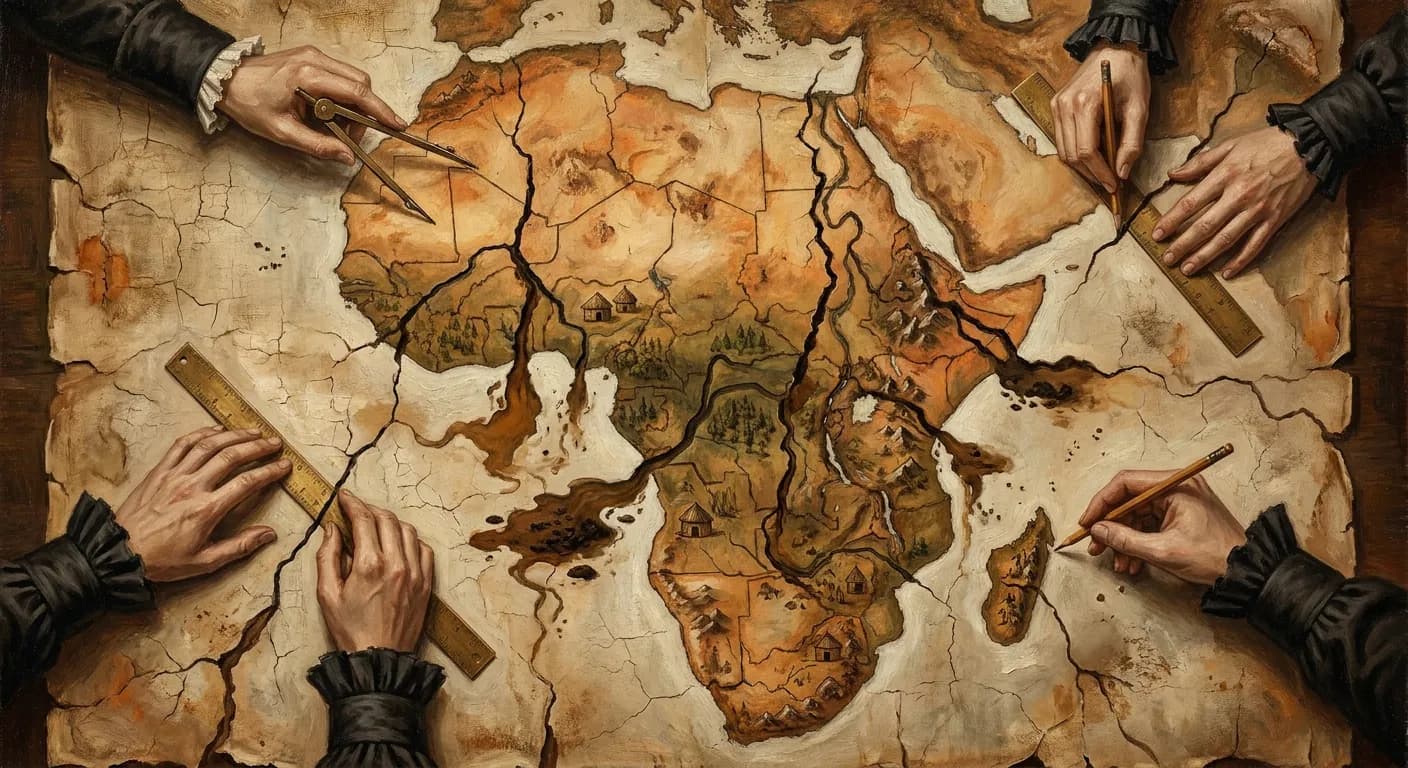
Look at a map of Africa today. Really look at it. You will notice something strange: enormous stretches of the borders are perfectly straight. Not the gentle curves of rivers, not the jagged contours of mountain ranges, not the organic edges of where one language or culture transitions into another. Straight lines. Ruler lines. Roughly 44% of African borders follow lines of latitude and longitude, slicing through pre-existing ethnic groups, river basins, and migratory routes with the geometric indifference of a grid overlay.ix
A straight line on a political map is almost always a confession. It says: the people who drew this border did not know, or did not care, what was on the ground. Natural borders—rivers, mountains, watersheds—are curved because the earth is curved and complicated. Human borders—the edges of kingdoms, language zones, trade networks—are curved because human life is curved and complicated. A straight line means someone far away had a ruler and a theory. It means the map was drawn before the territory was understood. Or, more precisely, it means the territory was understood differently than we might assume: not as a place where people lived, but as a surface to be divided.
The consequences of this geometric violence have been staggering and ongoing. The Maasai were split between British Kenya and German Tanganyika. The Ewe were divided between British Gold Coast and French Togoland. The Somali people were fractured across five different colonial territories—British Somaliland, Italian Somaliland, French Somaliland, Ethiopian Ogaden, and Kenya's Northern Frontier District—a partition whose aftershocks still drive conflict in the Horn of Africa today. These aren't ancient grievances. These are active wounds. The localized border frictions generated by lines drawn in European drawing rooms remain live conflicts well into the 2020s.
The Logic of Nobody's Land
There is a concept in European law called terra nullius—literally, “nobody's land.” It was the legal fiction that made the Scramble possible. If Africa was empty—if there were no real nations, no real laws, no real sovereignty—then European occupation wasn't conquest but settlement. Wasn't theft but development. Wasn't invasion but, per Article 6, the improvement of “moral and material well-being.”
The reality, of course, was that Africa in the late nineteenth century was home to an extraordinary diversity of political systems—from the vast Sokoto Caliphate in what is now Nigeria, one of the largest states in the world at its peak, to the Zulu Kingdom, to the Ethiopian Empire, which would famously defeat the Italian army at the Battle of Adwa in 1896, to hundreds of smaller polities with sophisticated systems of governance, trade, and law. The continent was not empty. It was full. Full of people, full of history, full of power structures that the Berlin Conference deliberately erased by declining to seat a single African representative.
And here is the part that I find myself returning to, the paradox that reveals the lie at the center of the entire enterprise: if Africa was terra nullius, why did you need treaties? If these were not real nations, why did you need King Lobengula's signature? The answer is that the colonizers knew perfectly well they were dealing with sovereign peoples. They needed the treaties precisely because the land was not empty, because there were real kings with real armies who could make real trouble. The legal fiction of terra nullius was maintained not because anyone believed it, but because it was useful. It allowed European governments to tell their own citizens, their own parliaments, their own courts that what was happening in Africa was lawful. The treaties were for the Africans. The doctrine of terra nullius was for the Europeans.
The Inheritance
I want to end this first part of our series with something that happened nearly eighty years after the Berlin Conference, because it reveals how completely the lines on the map became the map itself.
In July 1964, the newly formed Organization of African Unity met in Cairo and passed Resolution AHG/Res. 16(I), in which member states “solemnly declare that all Member States pledge themselves to respect the borders existing on their achievement of national independence.”x The new African nations, born from the fires of decolonization, looked at the arbitrary borders drawn by their oppressors—the straight lines, the ethnic partitions, the geometric absurdities—and chose to keep them. They invoked a Roman legal principle called uti possidetis juris: as you possess under law, so shall you possess. The colonial borders would stand.
This was not naivety. It was pragmatism of the most painful kind. The new African leaders understood that if they began redrawing borders along ethnic or linguistic lines, every border on the continent would be contested simultaneously. The result would have been decades of continental war, played out atop Cold War proxy conflicts, with nuclear-armed superpowers feeding arms to every side. The OAU resolution was a survival tactic. It was also a tragedy—a moment where the victims of the Scramble were forced to ratify its results because the alternative was even worse.
This is what I find most devastating about the lines on the map: they were designed to serve the interests of the people who drew them, but they have outlived those people, outlived those empires, and become structural features of reality itself. The Berlin Conference lasted three months. Its borders have lasted almost a century and a half. The men in that room are long dead, but the lines they drew are still wounding.
In Part II, we will follow those lines into the territories they created, where the principle of “effective occupation” was enforced not with treaties but with machine guns, concentration camps, and extermination orders. The violence of conquest. The part of the story that empires most desperately want you to forget.
Sources & Further Reading
- i.Berlin Conference — Wikipedia
- ii.Thomas Pakenham, The Scramble for Africa — Oxford University Press
- iii.General Act of the Berlin Conference, Article 35 — SDSU
- iv.General Act of the Berlin Conference, Article 6 — AfroLegends
- v.The Rudd Concession — Zimbabwe Field Guide
- vi.King Lobengula Quotes — QuoteFancy
- vii.King Lobengula's Envoys to Queen Victoria — AfroLegends
- viii.Hilaire Belloc, The Modern Traveller — African Poems
- ix.Arbitrary Borders in Africa — AfroLegends
- x.OAU Cairo Resolution AHG/Res. 16(I), 1964 — African Union
Part II: The Violence of Conquest
A new exploration goes up most days. Nothing to sign up for.