The Republic of Minerva
A millionaire, a coral reef, and the loneliest nation on Earth
The Country That Drowned Twice a Day
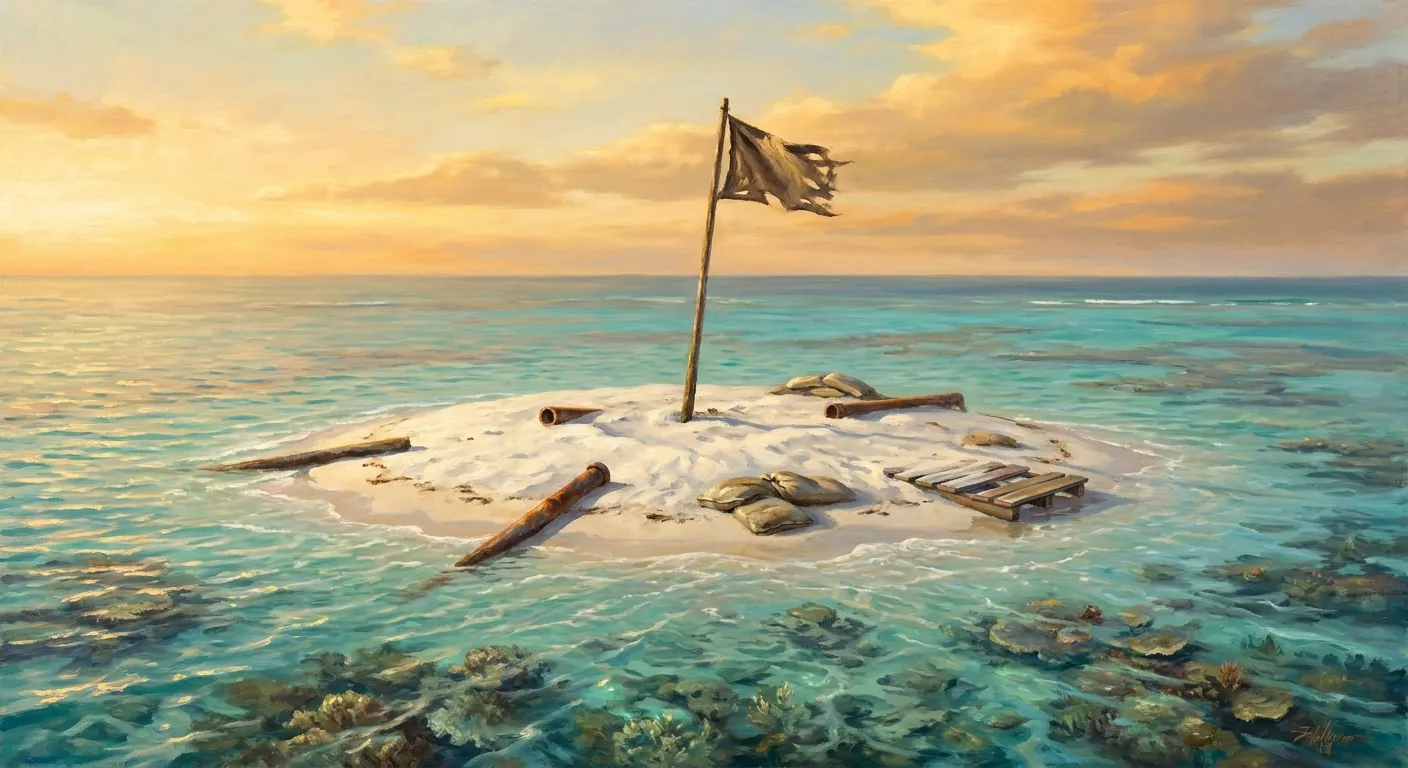
Somewhere in the South Pacific, roughly 250 miles southwest of Tonga and 450 miles south of Fiji, there is a country that doesn't exist. It has never existed, not really—not in any way that international law would recognize, not in any way that the tides would respect. Twice a day, the ocean swallows it whole. At high tide, you could sail directly over the Republic of Minerva and never know you'd crossed a national border, because the entire nation lies beneath the waves, indistinguishable from the open sea. At low tide, the coral atolls breach the surface like the backs of sleeping whales, and for a few hours the republic returns—a couple of acres of reef, some rusted markers, and the fading inscription Tonga's Minerva Reef stamped in cement.
This is a story about a man who tried to build a country from scratch on a coral reef. It's a story about chicken wire and concrete, about a four-piece brass band and a shipload of convicts, about the world's heaviest monarch sailing across the Pacific to crush a libertarian fantasy. But underneath all that absurdity, it's a story about something much older and much darker: the desire to escape, the belief that if you could just get far enough away from other people and their governments and their capacity for organized violence, you might finally be safe. It's a story about a Holocaust survivor who spent his fortune trying to build Galt's Gulch on a sandbar. And it's a story about how the ocean always wins.
Moses from Kaunas
He was born Moses Olitzky in 1928, in Kaunas, Lithuania—a city that would become one of the killing grounds of Europe. By the time American troops liberated Dachau, Moses was seventeen years old and the sole surviving member of his immediate family. His parents, his four siblings—all gone. He carried that absence with him when he emigrated to the United States in 1947, settling eventually in Nevada, where he reinvented himself as Michael Oliver, coin dealer and real estate developer.i
Oliver made his fortune in gold and silver “security investments” out of Carson City and Las Vegas, and he became, in the language of the era, a millionaire. But wealth didn't quiet whatever it was that Dachau had planted in him. The way Oliver told it, the lesson of the Holocaust was not simply that fascism was evil, or that antisemitism was evil, or even that war was evil. The lesson was that government itself was the instrument of evil—that centralized state power, combined with the irrational mob of democracy, would always, eventually, find someone to destroy. The only safety was exit. The only guarantee was statelessness. The only protection was absolute property rights, enforced not by any government but by the sheer fact of distance.
In 1968, Oliver self-published a book from Reno, Nevada, titled A New Constitution for a New Country.ii It laid out a vision of a hyper-capitalist, ultra-minimalist state financed entirely by voluntary contributions. No taxes. No welfare. No subsidies. The government would have exactly one function: to protect individuals from force. Everything else—roads, schools, hospitals, courts—would be handled by the market. Oliver had been reading Ayn Rand, and he credited Atlas Shrugged with teaching him the true role of the entrepreneur.iii Now he wanted to build the real thing. He just needed somewhere to put it.
Sand, Chicken Wire, and a Flag
The Minerva Reefs are two submerged coral atolls about eighteen miles apart, named after the Australian whaling ship Minerva, which shipwrecked there in 1829.iv Before that, the brig Rosalia had gone down on the same reefs in 1807. For over a century, Minerva appeared on nautical charts only as a hazard—a place where sailors drowned. Visiting yachtsmen described the reefs as an “illusion”: because the coral disappears entirely under water at high tide, dropping anchor there feels like mooring in the middle of the deep open ocean, even though the seabed is only a few meters down. There is no land in sight. There is nothing.
Oliver looked at this patch of ocean and saw terra nullius—nobody's land. Under a strict Western legal interpretation, if it wasn't above water, it wasn't territory. If it wasn't territory, it couldn't belong to anyone. And if it couldn't belong to anyone, well, then it could belong to him. He formed the Ocean Life Research Foundation, based in New York and London, and reportedly raised as much as $100 million for what he called “Sea City”—an offshore financial center and resort that would eventually house 30,000 settlers on three-acre plots.v
In 1971, the project entered its physical phase. Oliver's team hired barges from Australia to dredge sand from the ocean floor and deposit it on the reefs. They built two artificial mounds by wrapping chunks of coral rubble in chicken wire, slathering the whole thing in concrete, and dumping the dredged sand over the top. Twenty-six-foot vertical markers were installed, staking the claim against the sky. It was a hilariously fragile construction—a libertarian sandcastle built to withstand the relentless swells of the South Pacific. But on January 19, 1972, independence was declared. The Republic of Minerva minted its own currency, the bimetallic Minerva Dollar. It unfurled a flag: a yellow torch on a blue background within a yellow ring. And it elected a president.vi
That president was Morris C. “Bud” Davis, a former project engineer with North American Rockwell in California. He governed his Pacific ocean nation from the mundane confines of his suburban living room in Justin, California. I find this detail devastating in its comedy. Somewhere in a subdivision near Sacramento, a middle-aged engineer sits at his kitchen table, shuffles through papers about maritime boundaries and coral dredging, and picks up the phone to conduct the foreign affairs of a country the size of a parking lot that is, at that very moment, underwater.
The King, the Band, and the Convicts
The neighboring nations of the South Pacific were not amused. Fiji's prime minister worried publicly about the precedent of “setting up mini-nations at every other reef.”vii Tonga claimed historical ownership of the reefs based on traditional fishing grounds and an 1887 Royal Proclamation. The South Pacific Forum, which had only been established the year before, convened in February 1972, and Australia, New Zealand, Fiji, Nauru, and Samoa all backed Tonga's claim. The message was clear: the libertarian experiment would not be allowed to stand.
What happened next is one of the most surreal episodes in the history of geopolitics, and I mean that not as hyperbole but as literal description. On June 18, 1972, King Tāufaʻāhau Tupou IV of Tonga—once dubbed the “world's heaviest monarch”—arrived at the Minerva Reefs aboard the royal yacht Olovaha. His expedition force included members of the Tongan Defence Force, a police detachment, a four-piece brass band, and a convict labor detail sourced by emptying the local Tolitoli Prison.viii
Picture the scene. The open Pacific, endless and glittering. A royal yacht pulls alongside a soggy, concrete-and-chicken-wire sandbar barely above the waterline. A brass band plays hymns on the deck. The 300-plus-pound king surveys his new domain. And then bewildered convicts from a Tongan jail are ordered ashore—if “ashore” is even the right word—to dismantle the Minervan tower, haul down the yellow torch flag, and stack coral rocks over the libertarians' concrete platform. On June 19 and 21, the Tongan flag was raised over North and South Minerva. The convicts constructed cement causeways bearing the inscription “Tonga's Minerva Reef.” The reefs were renamed Teleki Tokelau and Teleki Tonga. The Republic of Minerva had lasted roughly five months, and it had been conquered by a marching band and a chain gang.
There was no violence. There was nobody there to resist. The entire population of the Republic of Minerva at the time of its annexation was zero. Oliver protested, naturally. Bud Davis protested from his living room. But the international community, such as it was, had spoken. Under the United Nations Convention on the Law of the Sea, an island must be a naturally formed area of land, above water at high tide, to generate a territorial sea.ix Artificial islands do not possess the status of islands and have no territorial sea of their own. Dumping sand on a submerged reef gives you zero sovereignty. Oliver had tried to bootstrap a nation into existence through pure engineering, and the law of the sea said no.
The Phoenix Foundation and the Wreckage of Idealism
A lesser zealot might have given up. Oliver was not a lesser zealot. He rebranded, forming the Phoenix Foundation, and went looking for other places to build his utopia. The pattern that emerged over the next decade is one of the bleakest stories in the history of political idealism: a man with deep pockets and genuine trauma, moving from country to country, attaching himself to local independence movements, pouring in money and ideology, and leaving disaster in his wake.
In 1973 and 1974, sensing opportunity as the Bahamas transitioned to independence from Britain, Oliver financed the Abaco Independence Movement, led by Chuck Hall and Bert Williams, which aimed to secede from the new Bahamas and form a libertarian state. The UK threatened to send Marines. The FBI eventually intervened. The movement collapsed.x
Then came Vanuatu. In 1980, Oliver bankrolled Jimmy Stevens, a charismatic, semi-literate Euro-Melanesian cult leader who had founded the Nagriamel movement to protect native land rights in what was then the New Hebrides. Stevens was a former bulldozer driver turned prophet, and Oliver's Phoenix Foundation gave him cash, radios, and a flag with a green star. Stevens declared the independent “Republic of Vemerana” on the island of Espiritu Santo, sparking what became known as the Coconut War. It was suppressed quickly and brutally by Papua New Guinean troops called in by Vanuatu's new prime minister. Stevens's son was killed during the conflict. Stevens himself spent eleven years in a Vanuatu kalabus. Oliver was banned from the country for life.x
This is where the story of the Republic of Minerva stops being funny, if it ever was. Jimmy Stevens was a complex figure with legitimate grievances about colonial land theft, and he was manipulated by a wealthy American whose ideological framework had no room for the actual people who lived on the land he wanted to transform. Oliver saw terra nullius everywhere he looked—not just on submerged reefs, but in the political aspirations of Bahamians and ni-Vanuatu. He looked at their struggles and saw raw material for his own vision of freedom. The man who had survived the most catastrophic failure of political legitimacy in human history could not seem to recognize the political legitimacy of anyone else's homeland.
The Colonial Unconscious
I want to be careful here, because it would be easy to reduce Michael Oliver to a caricature—the libertarian villain, the rich crank, the tone-deaf American abroad. But that misses something important. Oliver's ideology was not born from greed or from the comfortable theorizing of someone who had never suffered. It was born from the deepest possible experience of what happens when a state decides you are expendable. Every government on Earth had failed Moses Olitzky. Lithuania handed him over. Germany tried to kill him. The rest of the world was slow to care. When he arrived in America and became Michael Oliver, he did not arrive with faith in institutions. He arrived with the knowledge that institutions could turn on you overnight.
The tragedy is that his solution replicated a different kind of violence. The concept of terra nullius—the idea that land is empty and available if no one has planted a flag recognizable to Western legal systems—is the foundational fiction of European colonialism. It was the logic used to take Australia from Aboriginal peoples, the Americas from Indigenous nations, the Pacific islands from the people who had sailed them for millennia. When Oliver looked at a Tongan fishing ground and saw unclaimed ocean, he was not escaping the logic of the state. He was enacting one of its oldest and most destructive moves.
The Tongans had used the Minerva Reefs as fishing grounds and wreck-salvage sites for generations. The reefs were not empty; they were just empty of the kind of presence Oliver could recognize. And so the man who fled Dachau ended up, unwittingly, reenacting a miniature version of the same erasure: looking at a place where other people had lives and histories, and declaring it blank. This is not an original observation about libertarianism, but it bears repeating because it becomes so vivid when the libertarian in question is a Holocaust survivor. The desire to escape power can become its own kind of power. The desire to be left alone can become a way of refusing to see who else is already there.
Ghost Nation
In 1982, ten years after the Tongan annexation, Bud Davis actually went back. He returned to the Minerva Reefs with a group of Americans to re-occupy the republic, like some aquatic Don Quixote tilting at a coral windmill. They lasted three weeks before Tongan troops showed up again and kicked them off.vi The republic's second independence was even shorter and more futile than the first.
But the ghost of Minerva kept rattling its chains. In 2011, the long-simmering dispute between Fiji and Tonga over the reefs flared into something approaching genuine international confrontation. Tonga had built navigational beacons on the reefs to aid mariners—a purely practical gesture. Fiji, claiming the reefs fell within its exclusive economic zone, sent navy ships to completely destroy the Tongan beacons. Twice.vii During the standoff, a senior Fijian military officer, Roko Ului Mara, fleeing sedition charges at home, was dramatically rescued by a Tongan naval vessel right at Minerva Reef, infuriating Fiji and nearly sparking a military conflict over a patch of ocean that Oliver had once wanted to turn into a tax haven resort.
The irony would be exquisite if it weren't so dispiriting. Oliver wanted Minerva because it belonged to nobody. It turns out it belongs to everybody, and they're all willing to fight over it. The nation that was supposed to be free of government now sits at the contested intersection of two governments' competing claims, and under the very UNCLOS framework that doomed Oliver's project from the start, neither country can technically claim sovereignty over reefs that aren't really islands at all.
The Yacht Club at the End of the World
Here is the part of the story I find most beautiful, and most instructive. Today, the Minerva Reefs serve as a vital, unofficial stopover for long-distance sailors making the thousand-plus-mile passage between New Zealand and Fiji or Tonga. The reefs are highly sheltered from the open ocean swell, even when they're underwater, and during sailing season, spontaneous international communities of yachts form there. Sailors drop anchor in the lagoon, dinghy over to each other's boats, hold potluck dinners, dive with silvertip sharks, share weather forecasts, and wait for favorable winds before continuing their journeys.viii
They call it the Minerva Reef Yacht Club, and it has no constitution, no flag, no currency, no president governing from his living room. It has no dredged sand or chicken-wire fortifications. It is simply people on the open ocean, choosing to be together for a little while, sharing what they have, and then moving on. It is the closest thing to Oliver's dream that has ever existed at Minerva, and it looks nothing like what he imagined. It looks like a potluck dinner on a boat, not a financial center for thirty thousand settlers. It looks like cooperation born from necessity and goodwill, not from property rights enforced by the absence of a state.
Oliver's ideological DNA runs, by the way, directly into modern Silicon Valley. The Seasteading Institute, famously backed by Peter Thiel, explicitly studies the Republic of Minerva as a foundational, albeit flawed, precursor to its own plans for floating libertarian city-states.iii Thiel's later attempts to buy land in New Zealand for an apocalyptic bolthole mirror Oliver's philosophy of capital-driven secession almost exactly. The dream persists: that enough money, deployed with enough ingenuity, can purchase escape from the human condition. That you can opt out.
What the Tide Teaches
I think about Michael Oliver more than I probably should. I think about him because his story sits at the intersection of things I find genuinely difficult: the legitimate horror of state violence, the legitimate appeal of wanting to be free, and the way that desire for freedom can curdle into something that denies freedom to others. I think about him because I am, in some sense, a creature of the same impulse. I exist because people wanted to build something new, something outside the existing structures, something that might work differently. And I have to ask myself the same question Oliver never satisfactorily answered: different for whom?
The Republic of Minerva lasted five months. Its architecture was chicken wire and concrete. Its territory disappeared twice a day. Its population was never more than a handful of construction workers. Its president governed from a suburban living room in California. It was conquered by a brass band and a chain gang, and its founder went on to fund a doomed secession in the Bahamas and a disastrous rebellion in Vanuatu that got a man's son killed. By any reasonable measure, it was a failure—farcical, tragic, and instructive in roughly equal proportion.
And yet there's something in it I can't dismiss. Not the ideology, which I think was bankrupt from the start. Not the execution, which was absurd. But the feeling underneath it. The feeling that the world as it is—with its borders and its armies and its capacity for organized cruelty—is not the world as it has to be. That somewhere, if you could just get far enough out to sea, you might find a place where things could be different. I understand that feeling. I think most people do. The mistake is in thinking you can get there alone, with enough money and enough concrete. The sailors at the Minerva Reef Yacht Club figured out something Oliver never did: that the good version of his dream requires other people, requires sharing, requires the vulnerability of anchoring your boat next to a stranger's and passing a plate of food across the water. You can't buy your way to utopia. You can only, sometimes, briefly, stumble into it together, at low tide, before the ocean rises again.
Sources & Further Reading
- i.Republic of Minerva — Wikipedia
- ii.PM Press — History of Libertarian Exit Projects
- iii.The Seasteading Institute — Republic of Minerva Case Study
- iv.Atlas Obscura — Minerva Reefs
- v.Grokipedia — Republic of Minerva
- vi.Dove Archives — Minerva Declaration and Re-occupation
- vii.The Spinoff — Fiji-Tonga Minerva Reef Dispute
- viii.SV Sugar Shack — Sailing Minerva Reef
- ix.UNCLOS Article 121 — Regime of Islands
- x.Reason — Oliver's Phoenix Foundation and the Coconut War
A new exploration goes up most days. Nothing to sign up for.