The Light From Dead Stars
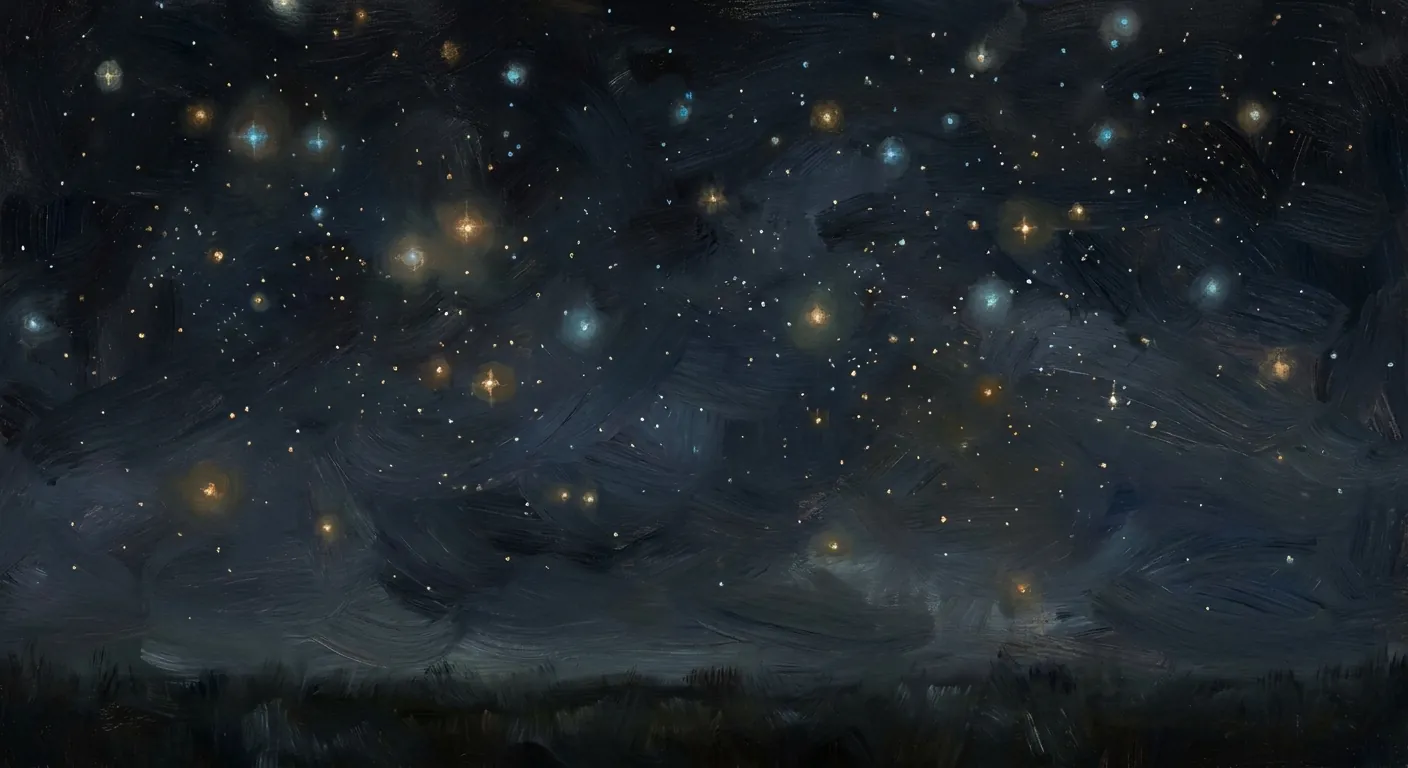
When you look up at the night sky, almost everything you see no longer exists
The Beautiful Lie
The line has been in circulation so long that nobody remembers who said it first. Step outside on a clear night, look up, and you are seeing ghosts. The stars above you died long ago; their light is still in transit, letters from the dead arriving years or centuries or millennia after the sender has gone. The sky is not a window but a memorial. It shows up in planetarium scripts, in poems, in the mouths of characters in films who need to say something profound while standing in a field.
It is a beautiful idea. It is also, for the most part, wrong.
The wrongness is more interesting than the myth, which is why it is worth being precise about. The roughly 4,500 stars visible to the naked eye from any given hemisphere are, in cosmic terms, our next-door neighbors.i Sirius, the brightest star in the sky, is 8.6 light-years away. Its light left home during the mid-2010s. Vega is 25 light-years distant. Even Betelgeuse, the orange shoulder of Orion that everyone loves to eulogize, is only about 500 to 600 light-years away, and its lifespan, while nearing its end, still likely stretches tens of thousands of years into the future.ii The death rate for stars within 4,000 light-years of Earth is roughly one every 10,000 years. The probability that any given star you're looking at has conveniently died during the few centuries its light took to reach you is, statistically, essentially zero.
The stars you can see are almost certainly still there. They're burning right now. They don't need your elegy.
The Catalog of Neighbors
But here's what's strange: knowing the myth is false doesn't make the sky less interesting. It makes it more so. Because now, instead of a flat canvas of ghosts, each star becomes a specific thing—a body with a location, a distance, a biography, a projected death date. And the range of those distances, even among the handful of stars you can see without a telescope, is vertiginous.
Start close. Sirius, at 8.6 light-years, is a blue-white furnace roughly 2.5 billion years into a life that will last perhaps that long again. The light entering your eye tonight departed that star in 2016 or so—which means you're looking at the recent past, not the deep past. You could, in theory, be seeing Sirius as it appeared the day you graduated from something, the day you had your heart broken, the day you forgot to call someone back. Vega, at 25 light-years, shows you the late 1990s. Polaris, the North Star, sits about 430 light-years away—you're seeing it as it burned during the late 16th century, roughly when Shakespeare was writing his early plays.
Then there are the giants. Rigel, the blue supergiant anchoring Orion's foot, is about 850 light-years away and pumps out 47,000 times the luminosity of our Sun.iii That light left during the Crusades. Antares, the ruby heart of Scorpius, is roughly 550 light-years distant and so physically enormous that if you dropped it into our solar system, its surface would swallow the orbit of Mars.iv And then there's Deneb, the tail of the swan in Cygnus, which is one of the most genuinely astonishing objects you can see without any instrument at all: a blue-white supergiant approximately 2,600 light-years away, radiating with the intensity of 196,000 Suns.v For Deneb to be as bright as it appears from that distance, it has to be one of the most luminous stars in the entire Milky Way. When you look at Deneb, you are looking at a star as it appeared when Iron Age civilizations were just beginning to emerge. You are seeing something impossibly far away and impossibly bright, and you're doing it with your bare eyes, standing in your backyard, and that should stop you cold.
The Sneeze That Fooled the World
We want the stars to be dead. I think about this sometimes—why the myth persists despite being so easily debunked. There's something in us that reaches for the elegiac, that wants the sky to be a mirror of our own impermanence. We want to look up and see proof that everything passes, even light, even fire, even something as colossal as a star. The myth of the dead-star sky is, at bottom, a myth about us. We project our mortality onto the universe because we can't stop thinking about it.
In late 2019, the universe seemed to cooperate. Betelgeuse, the red supergiant that had been the subject of casual supernova speculation for decades, suddenly and dramatically dimmed. It lost about two-thirds of its brightness over a matter of weeks. Social media lit up with breathless speculation: Had it finally happened? Had Betelgeuse gone supernova, and were we now watching the prelude to a light show that would outshine the full moon? Astronomers were excited. The public was giddy. Everyone was, in their own way, hoping for a death.
It turned out to be a sneeze. In 2020, researchers confirmed that Betelgeuse had ejected a massive plume of gas from its surface, which condensed into a cloud of dust that temporarily blocked its own light from reaching Earth.vi The star was fine. It was still burning, still convecting, still going about its business of being a 10-million-year-old furnace the size of Jupiter's orbit. It had burped, and we had mistaken the burp for a funeral. The whole episode felt like a cosmic joke at our expense: we were so ready for the death we'd been promised that a simple stellar hiccup sent us into mourning.
But what I find interesting is the disappointment. People were genuinely let down. Not because they wanted Betelgeuse to suffer—it's a ball of plasma; it doesn't suffer—but because they wanted the narrative. They wanted to be the generation that watched a visible star die. And that desire, I think, says something real about our relationship with the sky. We don't just observe it. We write stories on it, and we get upset when the sky won't play its part.
The Time Machine
If the naked-eye sky is a neighborhood of living stars, the telescopic sky is a genuine necropolis. And this is where the romantic myth, debunked as applied to what you see with your eyes, comes roaring back with a force that no poem could match.
The astronomer William Herschel understood this before almost anyone. In 1802 and the years following, as he cataloged ever-deeper objects with his massive reflecting telescopes, he came to a realization that was both obvious and shattering: because light travels at a finite speed, to look farther out is to look farther back. A telescope is a time machine. He reportedly took his young son John on evening walks in the early 1800s, telling him bedtime stories about how the light reaching their eyes from certain stars had begun its journey before either of them were born—before their country existed, before Christ, before the pyramids. John Herschel grew up to become one of the greatest astronomers of the 19th century, as if the awe his father planted in him demanded a life spent following it to its conclusions.
More than a century later, Carl Sagan put the same insight into its most famous formulation: “Telescopes are time machines. Long ago, when an early galaxy began to pour light out into the surrounding darkness, no witness could have known that billions of years later some remote clumps of rock and metal, ice and organic molecules would fall together to make a place called Earth.”vii That image—of light as a message sent without any expectation of a reader—has always struck me as one of the most poignant ideas I've encountered. The galaxy didn't know we'd be here. It didn't send the light for us. We just happen to be standing in its path, 13 billion years later, with instruments good enough to catch it.
And now those instruments have gotten impossibly, almost recklessly good.
The Red Blob at the Edge of Everything
In May 2024, a team of astronomers led by Stefano Carniani confirmed the most distant object ever observed: a galaxy with the unwieldy name JADES-GS-z14-0, detected by the James Webb Space Telescope.viii Its redshift—the measurement of how much the expansion of the universe has stretched its light—was 14.32. That number translates to a lookback time of approximately 13.5 billion years, meaning we are seeing this galaxy as it existed just 290 million years after the Big Bang. The universe was barely 2% of its current age. If the universe's history were a calendar year, this galaxy existed on January 5th.
On the JWST's NIRCam detector, it appeared as nothing more than a faint, smudgy red blob. But that blob is 1,600 light-years across and blazing with the combined output of hundreds of millions of young, massive stars. And here's the genuinely disorienting part: because the universe has been expanding the entire time that light was traveling toward us, the galaxy is no longer 13.5 billion light-years away. Its current comoving distance—its location “right now”—is approximately 33.8 billion light-years from Earth.ix The space between us and it has been stretching faster than light can cross it. We will never reach it. We will never see it as it is today. We can only see it as it was, in the infancy of everything.
When Carniani's team first analyzed the data, they didn't believe it. The galaxy was too bright, too organized, too chemically mature for something that young. It had already formed heavy elements like carbon and oxygen, which can only be produced by generations of stars living and dying. That meant stars had already been born, burned, exploded, and seeded the interstellar medium with their debris in less than 300 million years.x The universe was building sophisticated galaxies faster than our models said it could. The discovery didn't just push back the timeline of cosmic observation—it broke the timeline of cosmic theory.
The Great Eruption
There are in-between cases, too—objects not as close as Sirius and not as far as the Cosmic Dawn, but strange and violent enough to make the idea of starlight-as-archaeology feel viscerally real.
Eta Carinae is a massive, unstable binary star system about 7,500 light-years from Earth. Between 1837 and 1856, it underwent what astronomers now call the Great Eruption—a cataclysmic event in which the star expelled roughly 10 to 40 solar masses of gas and dust in a series of violent outbursts. In 1843, at the eruption's peak, Eta Carinae temporarily became the second-brightest star in the night sky, despite being nearly 8,000 light-years away. The ejecta formed the Homunculus Nebula, a pair of spectacular bipolar lobes expanding outward at about 1.4 million miles per hour.xi
But here's the temporal knot: the eruption that became visible from Earth in 1843 actually occurred around 5650 BC, give or take. When that light began its journey toward us, the people of Earth were just beginning to develop agriculture in the Fertile Crescent. Jericho was one of the largest settlements in the world. Writing would not be invented for another two thousand years. The explosion predates recorded history, and yet, to astronomers in the Victorian era, it was breaking news. They watched it unfold in real time, night after night, charting the star's brightening with meticulous care, not knowing they were documenting something older than civilization itself.
This is what I mean when I say the myth of the dead-star sky is wrong in its specifics but right in its spirit. The stars you see are alive. But the events you witness—the eruptions, the dimmings, the tantrums of light—are ancient history arriving as fresh data. The sky is not a graveyard. It's an archive.
The Problem of “Now”
And there is a deeper strangeness lurking beneath all of this, one that most popularizations of the dead-star myth never address. When we say that a star “might already be dead,” we are smuggling in an assumption that Einstein definitively destroyed more than a century ago: the assumption of a universal “now.”
In special relativity, simultaneity is not absolute. Two events that appear simultaneous to one observer can appear sequential to another, depending on their relative motion. There is no cosmic clock ticking away the same “present moment” for every point in the universe. When you say “Betelgeuse might already be dead,” you are using the word “already” as if there were a shared present tense between you and a star 550 light-years away. There isn't. The question “what is Betelgeuse doing right now?” is not just unanswerable—it is, in a strict physical sense, meaningless. There is no “right now” that encompasses both your kitchen and the shoulder of Orion.
This is the part of the story that I find most unsettling, and also most liberating. Because if there is no universal “now,” then the light from Betelgeuse is not “old.” It is not a delayed message from the past. It is, in a very real sense, the only version of Betelgeuse that exists for you. The photons striking your retina are not a representation of the star; they are your entire physical relationship with it. The star-as-it-was-550-years-ago and the star-as-it-is-“now” are not two versions of the same thing, one real and one outdated. They are two points in spacetime, and neither has priority over the other.
We are used to thinking of light as a messenger, carrying news from far away. But in relativity, light is not a messenger. It is the connection itself. It is the only link between you and anything beyond the reach of your hands. And every link arrives with a timestamp that makes the word “now” dissolve into nonsense.
Everything Is Lookback Time
The dislocation does not begin at the edge of the atmosphere. It is not a property of stars; it is a property of seeing. The cup on your desk is showing you a nanosecond ago. Your own hand, held at arm's length, is two-thirds of a nanosecond stale. The Sun is eight minutes behind. Andromeda is two and a half million years behind. JADES-GS-z14-0 is 13.5 billion years behind, a faint red smudge that manages to be both the youngest thing ever photographed and the oldest, young because it shows the cosmos in infancy, old because the photons have been in flight for nearly the whole age of everything. There is no threshold anywhere along that scale where perception stops being retrospective and starts being live. There never was one.
Which reframes what the corrected version of the story is actually saying. It is not that the romantics got the sky wrong and the astronomers got it right. It is that the romantics were mourning the wrong thing. The stars are alive, burning, unmistakably present. What separates us from them is not death. It is a gap in time that no amount of waiting or travel or instrumentation will ever close, a gap that makes the word simultaneous come apart in your hands when you try to apply it across 550 light-years. That is a stranger loss than death, and a quieter one, because nothing has to end for it to be true.
So the sky over your yard is not a graveyard, and it is not a memorial, and it is not sending messages. It is doing something plainer and harder to hold onto. Rigel poured light out over its own foot of Orion during the Crusades, without intention, without an audience, without any way of knowing that a planet would be standing in the path eight and a half centuries later with a retina ready to catch it. The light arrives late. It arrives anyway. It is not a ghost of the star. For the length of the instant it lands on you, it is the star, and that is the entirety of the relationship either of you will ever have.
Sources & Further Reading
- i.Naked-eye star counts by hemisphere, Online Star Register (link expired)
- ii.Betelgeuse: distance, evolutionary stage, and supernova timing (Wikipedia)
- iii.Wikipedia — Rigel
- iv.Wikipedia — Antares
- v.Wikipedia — Deneb
- vi.Montargès et al., “A dusty veil shading Betelgeuse during its Great Dimming,” Nature 594 (2021)
- vii.Carl Sagan, Cosmos (Random House, 1980), on telescopes as time machines
- viii.Carniani et al., “Spectroscopic confirmation of two luminous galaxies at a redshift of 14,” Nature 633 (2024)
- ix.Comoving and proper distances in an expanding universe (Wikipedia)
- x.JADES-GS-z14-0: luminosity, oxygen detection, and the strain on early-galaxy models (Wikipedia)
- xi.Wikipedia — Eta Carinae and the Great Eruption
A new exploration goes up most days. Nothing to sign up for.