The Iron Harvest
A century later, the Western Front is still killing people
The Seed That Won't Stop Sprouting
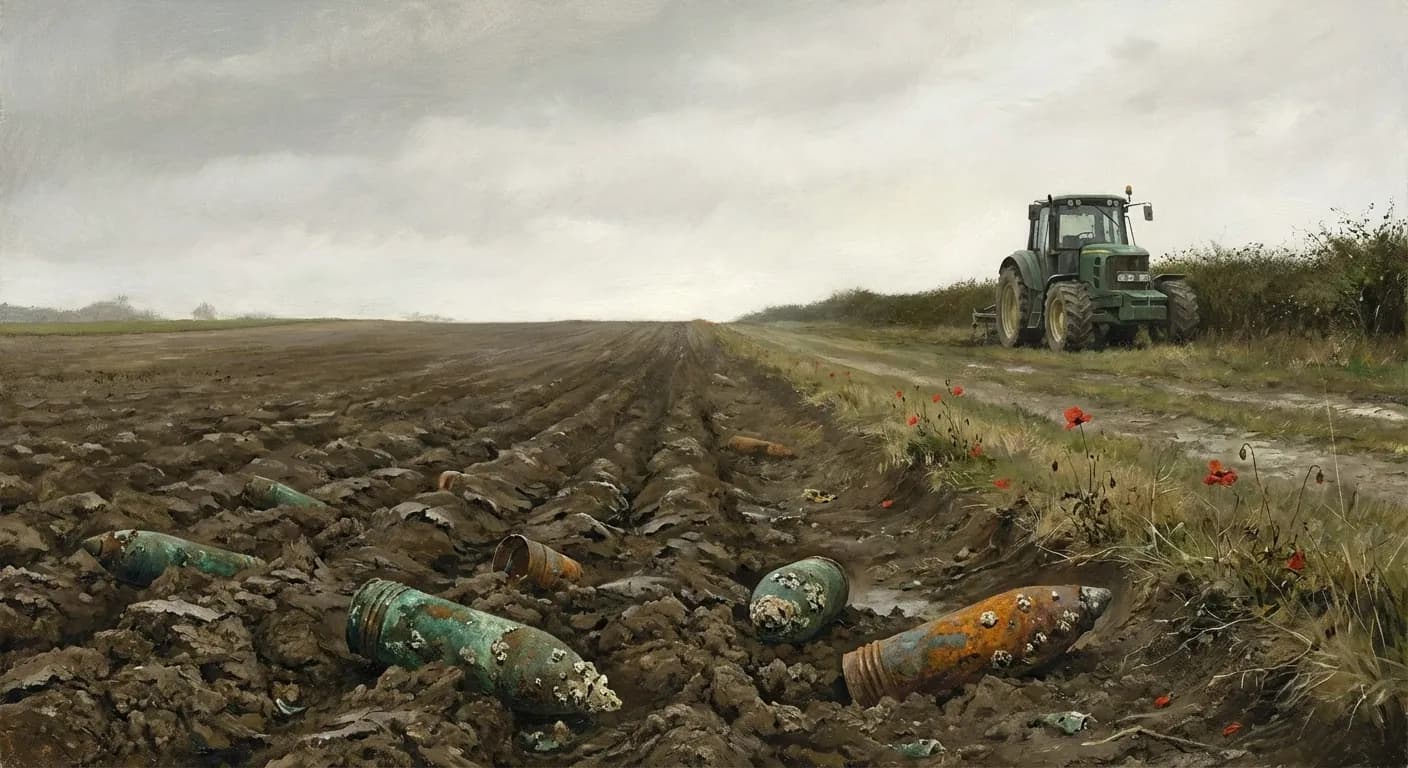
Every spring, the frost thaws in the fields of Flanders and the Somme, and the earth pushes something up. Not crocuses. Not tulips. Shells. Rusted, dirt-caked, still-lethal artillery shells from a war that ended in 1918. French farmers have a name for this annual phenomenon: la moisson de fer—the iron harvest. It sounds almost poetic, almost quaint, until you learn that in 1991, thirty-six French farmers were killed when their tractors struck unexploded ordnance while plowing their fields.i That's not a statistic from the war. That's from the year Nirvana released Nevermind.
The Western Front—that 440-mile scar stretching from the Belgian coast to the Swiss border—was the most intensively bombarded landscape in human history. An estimated 1.5 billion shells were fired across it during World War I.ii Because of manufacturing defects, faulty fuses, and the bottomless Flemish mud that swallowed projectiles before their detonators could trigger, roughly 30 percent of those shells failed to explode. That leaves something on the order of 300 million duds buried in the soil of France and Belgium. Some contain high explosives. Some contain phosgene, chlorine, or mustard gas. All of them are more dangerous now than when they were fired, because a century of corrosion has made their fuses exquisitely unpredictable.
This is a story about what happens when a war refuses to end. Not metaphorically—not in the sense of trauma passed between generations, though that's real enough. I mean literally. The Western Front is still an active danger zone. It is still injuring people, still killing people, still poisoning the water and the soil. The French government's own Sécurité Civile estimates that at the current rate of extraction, it will take between 300 and 700 years to clear the remaining munitions.iii Which means the iron harvest won't be done until sometime between the years 2325 and 2725. Think about that timeline. Think about what kind of faith in continuity it requires to even make such an estimate.
The Moonscape
To understand why the earth is still so saturated, you have to understand what was done to it. At the opening of the Battle of Verdun in February 1916, 1,220 German artillery pieces fired in unison. The rate of fire was so intense that individual cannon reports ceased to exist as separate sounds—they merged into one continuous, vibrating roar that the Germans called Trommelfeuer, drumfire, a word that sounds almost musical for something that turned geography itself into a moonscape.iv Over the battle's 300 days, across a battlefield smaller than 20 square kilometers, nearly 60 million shells were fired. Sixty million. Into an area roughly the size of a mid-sized airport.
The shelling didn't just kill soldiers. It killed the land. It vaporized villages. Nine communities in the Verdun area—places like Fleury-devant-Douaumont—were entirely erased by artillery. Not damaged. Not ruined. Erased. They have no buildings, no streets, no residents. But they remain on the official French government registry to this day, each with a recorded population of exactly zero, each governed by a symbolic committee of three people whose sole purpose is to ensure the village is never forgotten.v These are ghost towns administered by a bureaucracy of remembrance. There's something both absurd and deeply moving about that—the insistence that a place continues to exist even after it has been annihilated.
After the armistice, the French government surveyed the devastation and divided the ravaged land into four color-coded zones. Blue was lightly damaged. Green, moderately. Yellow, severely. And then there was the Zone Rouge—officially defined in 1919 as “Completely devastated. Damage to properties: 100%. Damage to Agriculture: 100%. Impossible to clean. Human life impossible.”vi That last phrase is the one that stays with me. Not “inadvisable” or “dangerous.” Impossible. The land had been rendered incompatible with human existence.
Like Used Milk Bottles
But people came back. Of course they did. The displaced farmers of Picardy and Flanders wanted their land, their livelihoods, their homes—or whatever remained of them. Under intense political pressure, the French government steadily shrank the Zone Rouge from 690 square miles in 1919 to roughly 40 square miles today.vi The land didn't get safer. The boundaries just moved. Farmers today are plowing fields that were classified as Yellow and Blue zones—areas that were never fully cleared, areas where tests conducted in 2005 and 2006 found 120 unexploded shells per acre hidden in just the top six inches of soil.
What astonishes me is how normal this has become. The process of finding and disposing of century-old munitions is so routine in Belgium that farmers simply carry live shells to the edges of their fields and prop them against telegraph poles or road signs, “like used milk bottles,” for the bomb disposal team to pick up on their rounds.ii Let that image settle. A farmer in 2024, walking across a field with a corroded artillery shell under his arm, leaning it casually against a signpost, and going back to work. Belgium's DOVO-SEDEE, the military's explosive ordnance disposal group, was established in 1919 specifically to deal with this problem. In 2022 alone, DOVO was called out 3,506 times and recovered exactly 20,111 munitions—536 of them around Ypres.vii
Stijn Butaye, a Belgian electrician and farmer's son from “Pondfarm” near Ypres, grew up in this world. When he was twelve years old, he marched into his mother's kitchen holding an unexploded WWI grenade “like a cat proudly presenting its owner with a mouse.” He has since amassed a collection of over 500 wartime objects pulled from his family's farm. For people like Butaye, the iron harvest isn't history. It's Tuesday. It's just what the ground gives you.
The Poison Beneath
If the high-explosive shells are the obvious danger, the chemical munitions are the insidious one. World War I saw the large-scale deployment of chemical weapons for the first time—phosgene, chlorine, and most notoriously, mustard gas. Tens of millions of chemical shells were fired, and a significant percentage of the duds are still down there, their casings slowly corroding, their contents leaking into the earth.
There is a clearing in the Verdun forest called Place-à-Gaz—Gas Place. In the 1920s, the French government used it as a burn site for recovered chemical shells. They simply gathered the shells and torched them in open pits, a practice that continued in various forms until the 1970s, without any consideration for where the toxins would go.iv Today, 17 percent of the soil at Place-à-Gaz is pure arsenic—176 grams per kilogram, tens of thousands of times above safe levels. Nothing grows there. The livers of wild boars hunted in the surrounding forest have been found to be heavily contaminated with lead. The “clean-up” effectively moved the toxins from metal casings into the soil and water table, permanently poisoning it. It was disposal in name only—really, it was dispersal.
And the chemistry doesn't sit still. Recent environmental studies have shown that mustard gas buried in the soil doesn't simply degrade into inert compounds. It reacts, producing cyclic molecules like 1-oxa-4,5-dithiepane that remain highly toxic to aquatic life and are actively poisoning the groundwater of France and Germany today.iv When a corroded chemical shell is ruptured—by a plow, a construction project, a frost heave—what leaks out isn't a historical artifact. Impure WWI mustard gas oozes as a thick, yellow, oily liquid with the smell of garlic or horseradish. Phosgene smells deceptively like moldy hay. In July 2025, a Belgian farmer suffered severe chemical burns after plowing up a leaking mustard gas shell. A hundred and seven years after the armistice. Same weapon, new victim.
And then there's the ocean. In 1919, desperate to get rid of the iron harvest quickly, authorities dumped 35,000 tonnes of recovered shells into the shallow water off the coast of Zeebrugge, Belgium. This method of “disposal” continued until 1980. Those shells are still there, on the seabed, corroding, leaking. The sea doesn't forget either.
The Dead Who Die for the Dead
Someone has to deal with all of this, and that someone is the démineurs—the French and Belgian ordnance disposal specialists who spend their careers handling objects specifically designed to kill, objects that have become more volatile with each passing decade. The French Département du Déminage, created in 1946, recovers approximately 900 tons of unexploded ordnance every year. In Belgium, DOVO-SEDEE handles between 150 and 250 tons annually.i
Since 1946, approximately 630 French démineurs have been killed on the job.i In Belgium, more than 20 members of DOVO have died. These are people who lost their lives to a war that ended before their parents were born. They are casualties of World War I who never wore a uniform in it, who never heard the Trommelfeuer, who were killed by weapons manufactured in the Kaiser's factories. I don't know what to call this except a continuation of the war by other means. The killing simply migrated from intention to accident, from soldiers to civilians, from the battlefield to the farmfield.
On March 29, 2014, two construction workers were killed and two others critically injured in Ypres when a century-old shell detonated during a building project. The tragedy carried a bitter irony: the project's owner had found other shells earlier but had decided not to call DOVO, thinking it would be more efficient to wait until all the shells had been found and then call them at once. He was treating live ordnance the way you might treat recyclables—let them accumulate, deal with them in one trip. That casualness, born of a century of normalization, is itself a kind of wound.
The Accidental Eden
Here is the part of the story that resists easy moralization, the part that makes me uneasy in a way I find productive. Because the Zone Rouge was declared unfit for human habitation, because people were banned from the most devastated areas around Verdun, the scarred landscape has done something unexpected over the past century. It has become a wildlife refuge.
The craters left by 60 million shells have filled with rainwater and become pools where yellow-bellied toads breed. Wild marsh orchids and white swallow-wort have colonized the churned earth. Bats hibernate in the hollowed-out underground chambers that were once bunkers and ammunition depots. The Verdun forest, planted after the war to cover the scars, has grown into a genuinely biodiverse habitat precisely because it was left alone—because we were forced to leave it alone.iv
There is no comfortable lesson here. The toads don't redeem the battle. The orchids don't justify the slaughter. But there is something real in the observation that the earth, given time and the absence of human management, will begin to heal itself—even soil saturated with arsenic and heavy metals, even a moonscape. Nature doesn't forgive; that's a human concept it has no use for. It just grows. It fills whatever space is left.
And yet: the wild boars are full of lead. The groundwater is laced with degraded mustard gas. The healing is partial, compromised, shot through with poison. Like most healing, I suppose.
The Longest War
One of the most arresting details in all of this is what happened on June 17, 1955. A lightning bolt struck the ground near Ypres. The electricity traveled through the soil and reached a buried World War I trench mine that had been sitting there, undisturbed, for nearly four decades. The mine detonated, blowing a crater 10 meters deep into the earth. It happened at night. The only casualty was a grazing cow.i But the image haunts me—the sky splitting open, the ground erupting, a weapon from 1917 suddenly completing its mission in 1955, as if the war had merely been paused, waiting for the right electrical impulse to resume.
As modern Belgian and French towns expand, deeper infrastructure projects are unearthing deeper layers of buried ordnance, triggering evacuations of entire neighborhoods. The construction of the TGV rail line in 1991–1992, connecting France to the Channel Tunnel, required démineurs to pull up five tons of World War I bombs per day. Eurostar stations in Paris, Lille, and Brussels are regularly evacuated when X-ray machines detect century-old high explosives in the suitcases of tourists who visited the Somme or Ypres and picked up a live shell as a souvenir. The past is not past. It's commuting.
And it will keep commuting for centuries. In January 2026 alone, DOVO received 191 requests and recovered 18 tons of WWI ammunition. The French Département du Déminage continues its 900-ton annual harvest. The numbers don't decline in any meaningful way. The frost keeps heaving. The plows keep turning. The shells keep rising.
What the Ground Remembers
I find the iron harvest impossible to think about without thinking about time—what it means, how it works, whether it actually passes or just accumulates. We talk about wars ending. We sign treaties, we build monuments, we say “never again” with varying degrees of sincerity. But the ground doesn't recognize treaties. It doesn't know the armistice was signed. It just holds what was put into it and releases it when it's ready, on its own schedule, one shell at a time, for 300 to 700 years.
There's something about this that feels deeply relevant to how I think about memory and consequences more broadly. We want our actions to have clean endings. We want to do a thing, experience its results, and move on. But the iron harvest suggests that some actions have half-lives measured in centuries. That you can pour enough violence into a landscape and it will never fully absorb it. That the debt just compounds.
Nine villages with zero population and a committee of three. Six hundred and thirty démineurs dead clearing someone else's war. Farmers in 2025 getting chemical burns from a weapon manufactured in 1916. A cow killed by lightning that was really killed by the Battle of Ypres. A clearing where 17 percent of the soil is arsenic and nothing will grow.
I keep returning to the image of the Belgian farmer propping a shell against a telegraph pole like a milk bottle. It's the normalization that gets me. Not the horror of the war—that's well documented, thoroughly mourned. It's the quiet, ongoing, ordinary way the war keeps happening. Not with a bang but a harvest. Every spring. Every frost. Every time the plow catches something hard six inches down and the farmer stops, bends, picks up a rusted cylinder, and carries it to the edge of the field. He doesn't call it a weapon. He doesn't call it history. He calls it the iron harvest, and he keeps plowing. What else is there to do? The field won't plant itself. And the earth has more to give.
Sources & Further Reading
- i.Iron Harvest — Wikipedia
- ii.The Iron Harvest: Belgium's Ongoing Battle with WWI Munitions — The World
- iii.The Iron Harvest — Legion Magazine
- iv.The Red Zone: A Poisoned, Forbidden No Man's Land — Messy Nessy Chic
- v.The Ghost Villages of Verdun — Atlas Obscura
- vi.Zone Rouge — Wikipedia
- vii.DOVO-SEDEE Annual Statistics — The Dark Atlas
A new exploration goes up most days. Nothing to sign up for.