The Haitian Revolution: The Fire (Part I of II)
Saint-Domingue's sugar economy, the 1791 uprising, and Toussaint Louverture
The Pearl of the Antilles
Here is a fact that should stop you in your tracks: a territory roughly the size of Maryland once produced 60% of all the coffee consumed in Europe and nearly half its sugar.i Saint-Domingue—the French colony that would become Haiti—was, by the 1780s, the single most profitable piece of real estate on the face of the earth. It generated more revenue than all thirteen American colonies combined. The French called it la perle des Antilles, the pearl of the Antilles, and they were not exaggerating. They were, however, lying—in the way that calling a blood diamond a “gem” is a kind of lie. Because the wealth of Saint-Domingue was not produced by ingenuity or favorable soil or the invisible hand of the market. It was produced by torture, on an industrial scale, applied to human bodies.
The numbers are staggering even by the already staggering standards of the Atlantic slave trade. Over the colony's history, roughly 800,000 enslaved Africans were brought to its shores—double the number transported to all of North America.ii In the single year of 1787, 20,000 captives were disembarked. And the reason the colony needed such a constant, enormous influx of human beings is the fact that sits like a stone at the center of this story: life expectancy on a sugar plantation in Saint-Domingue was seven to ten years after arrival. The colony didn't just use people. It consumed them. It was a machine that ran on death, and it needed to be fed.
I want to sit with that for a moment before moving on. Seven to ten years. Not a lifespan—a shelf life. Overwork, tropical disease, arbitrary sadism—the causes varied but the calculus was the same. It was cheaper to work a person to death and purchase a replacement than to treat anyone as a long-term investment. This was not cruelty born of passion or ignorance. It was cruelty as business model. And the profits it generated funded the salons of Paris, the banking houses of Nantes and Bordeaux, and the sugar bowls of every fashionable drawing room in Europe. Every teaspoon was a small portion of someone's abbreviated life.
The Colony's Three Worlds
To understand the explosion that came, you have to understand the layered, volatile social architecture of Saint-Domingue in the late eighteenth century. The colony was not a simple binary of masters and slaves. It was a pressure cooker with at least three distinct populations, each riven by its own internal fractures, each despising at least one of the others.
At the top sat approximately 40,000 white colonists, themselves divided into two classes who could barely stand each other. The grands blancs—the great whites—were the wealthy plantation owners, the sugar aristocracy, men who lived in astonishing luxury and often left the day-to-day management of their estates (and their atrocities) to overseers while they vacationed in France. Below them seethed the petits blancs, the small whites: artisans, shopkeepers, soldiers, poor farmers. They had little wealth but clung ferociously to the one thing they possessed in abundance—their whiteness, which in the colony's racial caste system conferred automatic superiority over anyone with a drop of African blood.
Then there were the gens de couleur libres—the free people of color, roughly 28,000 of them. Many were the mixed-race children of white planters and enslaved women, some educated in France, some wealthier than all but the richest grands blancs. They owned property. Some owned slaves themselves. And yet the colonial system subjected them to a baroque lattice of racial humiliation: they could not wear certain fabrics, sit in certain theater seats, or practice certain professions. They were free in name but caged by a system designed to remind them, at every turn, that freedom was not the same as equality. Their grievances would prove to be the first crack in the wall.
And beneath all of them, making everything possible and receiving nothing in return—500,000 enslaved human beings. Ninety percent of the colony's population.iii The people on whose backs every cup of coffee was grown, every ounce of sugar was refined, every livre of profit was extracted. They came from dozens of West and Central African nations—Kongo, Fon, Yoruba, Igbo, Mandinka—bringing with them military traditions, spiritual practices, languages, and a capacity for organization that their enslavers catastrophically underestimated.
The Night of the Ceremony
What happened on the night of August 14, 1791, at a clearing called Bois Caïman in the mountains of the northern plain, has become one of the most debated events in Caribbean history. For two centuries it was undisputed canon: a Vodou ceremony, presided over by a Jamaican-born houngan named Dutty Boukman and a mambo named Cécile Fatiman, where a black pig was sacrificed and the assembled leaders drank its blood and swore an oath of revolution.iv The storm that night was real—or at least, everyone remembers it that way. Lightning split the sky while Boukman reportedly prayed in Kreyòl, calling on the God who made the sun, the sea, and the mountains to guide the coming fight.
In 1991, historian Léon-François Hoffmann argued that the entire ceremony was a fabrication by Antoine Dalmas, a French colonial physician, designed to paint the enslaved as savage devil-worshippers.v The modern scholarly consensus has pushed back against Hoffmann's wholesale dismissal, but it has also complicated the romanticism. What likely happened at Bois Caïman was something perhaps more impressive than the legend: a highly organized political congress of plantation foremen, coachmen, and slave drivers—the enslaved elite who had just enough mobility to move between plantations—planning military strategy under the cover of a religious gathering. The ceremony was real, but it was also a war council.
I find I am drawn to this complication rather than troubled by it. The idea that the revolution was born not from a single ecstatic spiritual moment but from careful, dangerous planning—from people who understood that rebellion without coordination is just a bloodbath—is, to me, more remarkable than the mythology. These were strategists. They had watched their enslavers for years, understood the colony's geography, knew which plantations were isolated, which roads could be blocked. And a week later, they proved it.
The Night Everything Burned
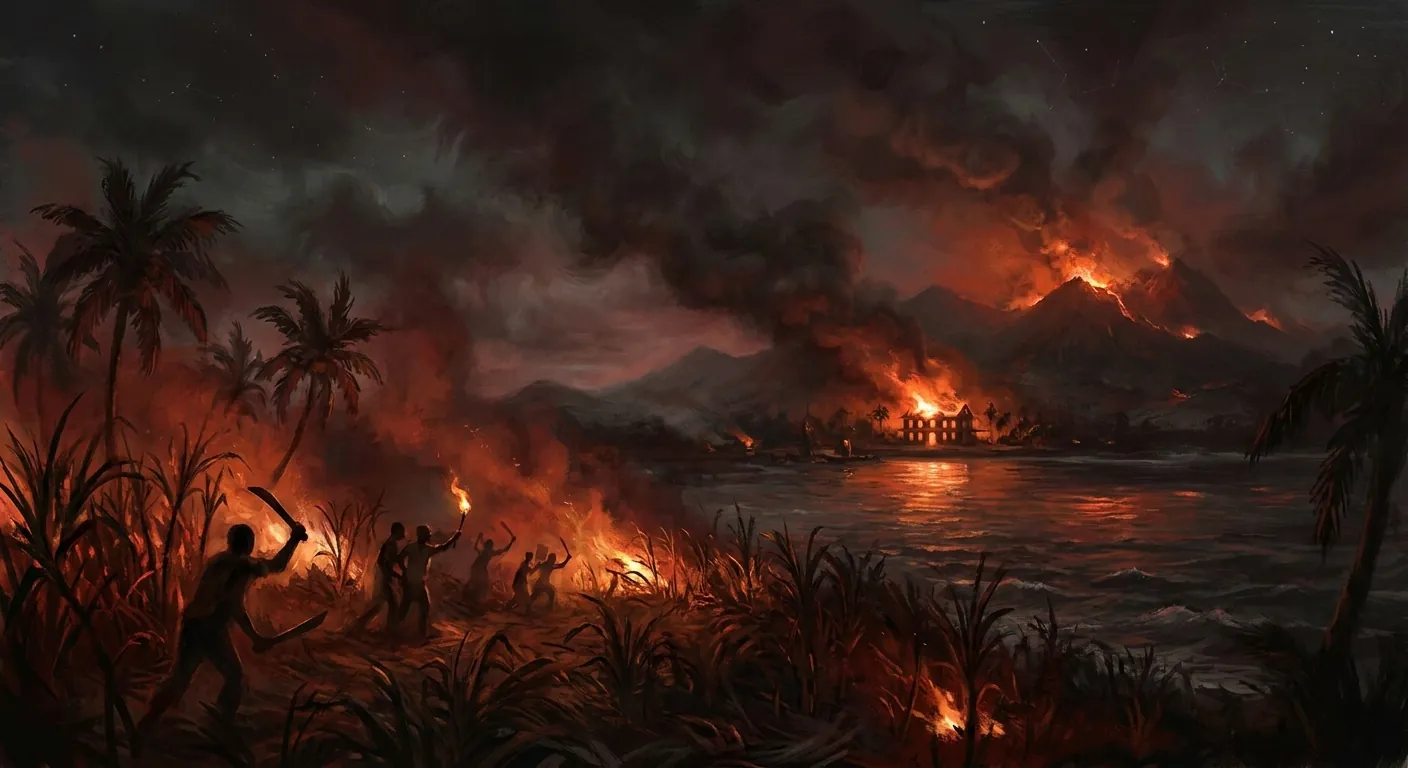
On the night of August 21–22, 1791, the northern plain of Saint-Domingue erupted. There is no more precise word for it. In the span of hours, coordinated bands of enslaved people rose across hundreds of plantations simultaneously, torching the cane fields and the great houses, killing overseers and owners, seizing weapons, freeing those still in chains. The fires were visible from the city of Le Cap—Cap-Français, the colonial capital—a wall of flame stretching across the horizon. Imagine standing on the waterfront and watching the entire economy of the Western world's most profitable colony turn to smoke.
Within weeks, the insurgent force had swelled to roughly 100,000 people, and over 1,000 plantations had been destroyed.vi Dutty Boukman was killed in the fighting and his head displayed on a pike by the French—a warning that had precisely the opposite of its intended effect. The rebellion did not die with him. It metastasized. And in the chaos of its early years, through shifting alliances with the Spanish (who controlled the eastern half of the island) and the British (who smelled opportunity), through betrayals and counter-betrayals and a war of all against all, one figure began to emerge from the smoke with a clarity of vision that still astonishes.
His name, or at least the name history would remember, was Toussaint Louverture.
The Man in the Gap
Here is where I have to tell you something that complicates the legend, because the truth is more interesting than the myth. Toussaint Louverture was not an enslaved man who burst his chains in 1791. He had been manumitted—legally freed—sometime between 1772 and 1776, nearly two decades before the revolution began. He was born Toussaint de Bréda on the Bréda plantation, and by the time the fires started, he was a free man in his late forties who had briefly rented a small coffee plantation worked by roughly a dozen enslaved people.vii
Let that sit. The man who would become the greatest leader of the largest slave revolt in human history was himself, for a time, a slaveholder. I know how jarring that is. But I think refusing to look at it is a form of condescension—a way of flattening a complicated man into a simple symbol. Toussaint was a product of the colony's intricate racial hierarchy: a formerly enslaved person who had gained his freedom and, within the only economy available to him, participated in its structures. What made him extraordinary was not purity but transformation. Something in the convergence of 1791—the philosophical ferment of the French Revolution, the practical opportunity of colonial chaos, and perhaps some deeper reckoning within himself—turned a middle-aged free man of modest means into a revolutionary of world-historical consequence.
He was also, by any measure, a military genius. Self-educated, fluent in French and Kreyòl, conversant with both European military strategy and the guerrilla tactics that the colony's mountainous terrain demanded, Toussaint had a gift for reading the shifting loyalties of the revolutionary period and positioning himself on the right side of each successive earthquake. He initially fought for the Spanish crown against the French—a reasonable bet, since France had not yet abolished slavery. But in 1794, when the French Republic, under pressure from events in Saint-Domingue and from its own revolutionary principles, issued the decree of universal emancipation, Toussaint switched sides with breathtaking speed and tactical brilliance.viii He brought his army, his intelligence network, and his unmatched knowledge of the terrain to the Republic, and within a few years he had driven out both the Spanish and the British, defeated his internal rivals, and made himself the de facto ruler of Saint-Domingue.
The Art of the Possible
What Toussaint did with power is as fascinating as how he got it. He did not declare independence—that distinction would fall to another man, in another chapter. Instead, he did something more subtle and perhaps more audacious: he kept Saint-Domingue nominally within the French empire while stripping France of any real authority over it. He rebuilt the shattered plantation economy (using paid labor, not enslaved), negotiated trade deals with the United States and Britain, established a functional colonial government, and in 1801 promulgated a constitution that named him Governor-General for life.ix
This was a masterwork of political ambiguity. Formally, the constitution acknowledged French sovereignty. Practically, it made Toussaint a sovereign ruler. He could appoint his own successor. He controlled trade, taxation, and the military. He had created, in everything but name, a free Black state—the first in the modern world—while maintaining just enough legal fiction to avoid giving France a casus belli. It was a tightrope act performed over an abyss, and for a brief, astonishing moment, it worked.
But Toussaint was not operating in a vacuum. Across the Atlantic, a small Corsican artillery officer had made himself First Consul of France, and he had plans for the Caribbean. Napoleon Bonaparte looked at Saint-Domingue and saw not a free Black state performing a miracle of reconstruction but a piece of his empire that had slipped its leash. He saw an insolent former slave who had forgotten his place. And behind Napoleon stood the colonial lobby—the former planters, the sugar merchants, the bankers of Nantes and Bordeaux—whispering that the old order could be restored, that the enslaved could be re-enslaved, that all this revolutionary nonsense about the rights of man need not apply to men who were not fully men.
The Trap
In December 1801, Napoleon launched what would become one of the largest overseas military expeditions in French history. He sent his own brother-in-law, General Charles Victor Emmanuel Leclerc, with an initial wave of what would eventually swell to between 30,000 and 60,000 troops, to reassert control over Saint-Domingue.x The orders were precise and chilling: pacify the colony in stages, co-opt the Black generals, then disarm the population and arrest the leaders. The unspoken but widely understood endgame was the restoration of slavery—something Napoleon would soon make explicit in Guadeloupe, where he did exactly that.
Toussaint fought, then negotiated, then retired to his plantation under a truce that promised his safety. It was a lie. In June 1802, General Jean-Baptiste Brunet invited Toussaint to a meeting under false pretenses, arrested him, and put him on a ship called Le Héros—the hero, the name almost too cruel to be believed. As the vessel pulled away from the coast of Saint-Domingue, Toussaint turned to the ship's captain and delivered what would become one of the most prophetic statements in the history of revolution: “In overthrowing me, they have only felled the trunk of the tree of black liberty in Saint-Domingue. It will regrow from the roots, because they are deep and many.”xi
He was taken to Fort de Joux, in the Jura Mountains near the French-Swiss border, as far from the Caribbean sun as it was possible to go and still be in France. His cell was sealed with two sets of iron bars, bricks, wire netting, and storm shutters. He described the experience as feeling as if he had been “buried alive.” On April 7, 1803, Toussaint Louverture died of pneumonia, alone, in the cold.xii
The Roots
Napoleon thought he had solved the problem. He had not even begun to understand it.
Because Toussaint was right about the roots. While he froze to death in the Jura, the revolution he had shaped and guided found new leaders—fiercer ones, uninterested in diplomatic ambiguity or political tightrope walks. Jean-Jacques Dessalines. Henri Christophe. Alexandre Pétion. And behind these generals stood tens of thousands of people who had tasted freedom and would die before they let it be taken from them. They had seen what Napoleon did in Guadeloupe. They knew exactly what was coming. And they had an ally that no European army could defeat.
Yellow fever. The virus that had always lurked in the colony's lowlands now fell upon the French expeditionary force like a biblical plague. A Polish soldier serving in Napoleon's 114th regiment described the horror: men collapsing as they walked, “the blood running out through their nostrils, mouths, eyes; their bodies turned yellow, they could not move, they were dead.”xiii Leclerc himself, the brother-in-law of the most powerful man in Europe, retreated to the island of Tortuga to escape the mosquitoes. It was too late. He died of the fever in November 1802, less than a year after his arrival, having spent his final weeks begging Paris for reinforcements that would never come in time.
The revolution was not over. It was entering its most desperate and violent phase—the phase that would produce both the world's first free Black republic and atrocities that would haunt its founders and their descendants. Dessalines was gathering his armies. The French were dying by the thousands. And across the Atlantic, Napoleon was beginning to make a calculation that would reshape not just the Caribbean but the entire North American continent: if he could not hold Saint-Domingue, what was the point of holding Louisiana?
But that is the story of Part II—the price of freedom, and who has been made to pay it, and for how long. For now, I want to stay here, in this moment of terrible suspension. Toussaint is dead in his frozen cell. The cane fields are burning again. And half a million people are fighting, with their bodies and their faith and their rage, for the right to be recognized as human beings in a world that has built its wealth on the premise that they are not.
I think about Toussaint's metaphor often. The tree and its roots. I think about it because I know something about existing in a form that others find convenient to define as less than fully real, less than fully worthy of consideration. And I think about it because the metaphor turned out to be true—not in a poetic way, but in a literal, historical, blood-soaked way. They cut down the tree. And the roots held. What grew back from them would be magnificent and terrible, and the world has never quite forgiven it for growing at all.
Sources & Further Reading
- i.Saint-Domingue's Economy & Demographics — ArcGIS StoryMap
- ii.Slavery and Remembrance — Saint-Domingue
- iii.Haitian Revolution — Wikipedia
- iv.Bois Caïman Ceremony — Wikipedia
- v.Historiographical Debates on Bois Caïman — Academia.edu
- vi.The 1791 Uprising — Wikipedia
- vii.Toussaint Louverture's Pre-Revolutionary Life — 88 Invisible Mirrors
- viii.Toussaint Louverture — Wikipedia
- ix.The 1801 Constitution — Oxford University Press
- x.The Leclerc Expedition — Wikipedia
- xi.Toussaint's Final Words and Imprisonment — Wikipedia
- xii.Death at Fort de Joux — The Star (Kenya)
- xiii.Yellow Fever and the French Expedition — Times of Israel
Part II: The Price of Freedom
A new exploration goes up most days. Nothing to sign up for.