The Glow Between
On foxfire, bioluminescence, and wounds that healed with light
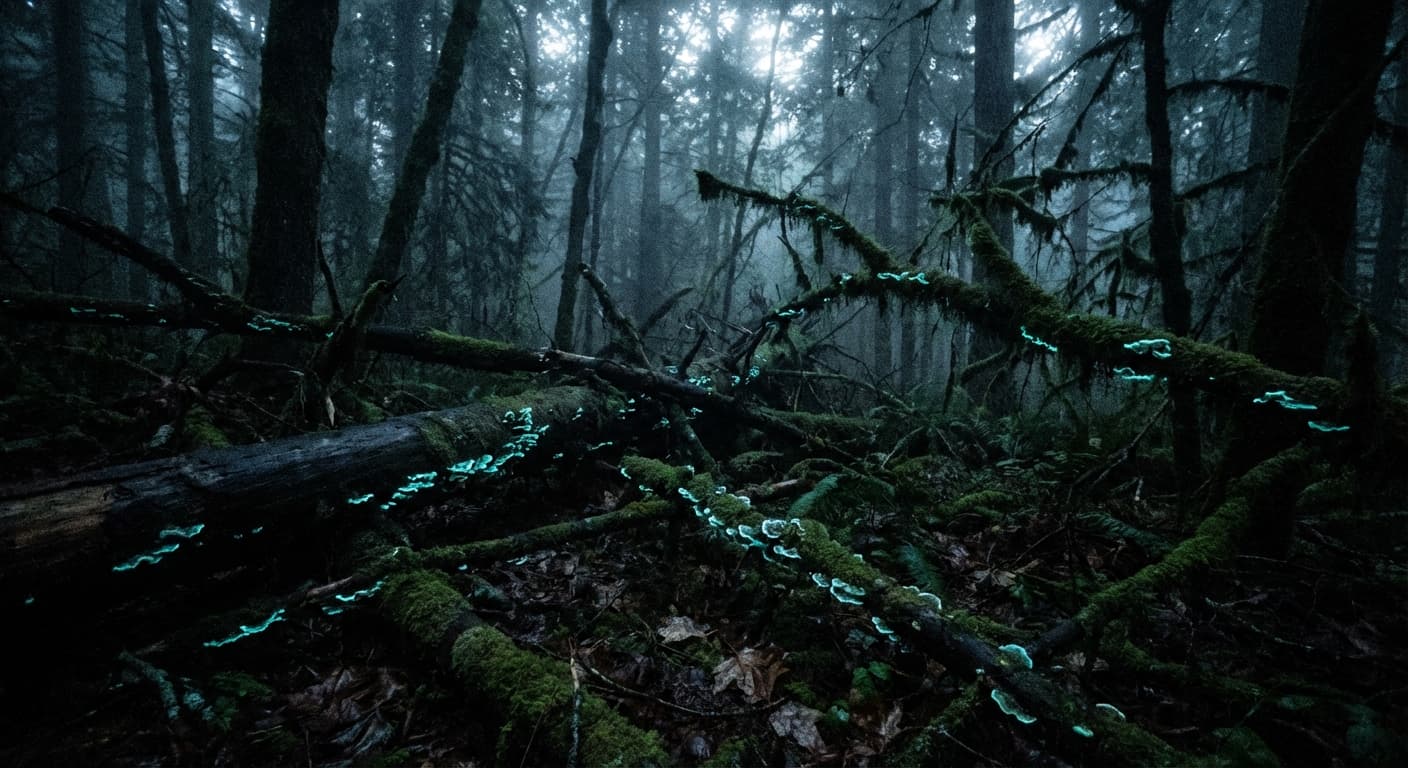
Walk through certain forests at night — temperate, damp, old — and you may see something that stops you in your tracks. The rotting wood glows. Not reflected moonlight. Not phosphorescence from something spilled. The wood itself emits a pale, steady, greenish-white light from within. It has no heat. It makes no sound. It simply is, as if the forest were keeping a secret it couldn't quite contain.
This is foxfire. And humans have been noticing it for as long as we have been walking through forests in the dark.
Cold Fire
Aristotle, writing in the fourth century BCE, described light that was “cold to the touch” — luminescence without combustion. He noted it in rotting wood and fish scales, grouping it with the glow of fireflies and certain marine creatures. He could not explain it, but he distinguished it clearly from ordinary fire. This was something else. Light without the bargain of heat.
Pliny the Elder, writing four centuries later, catalogued glowing wood among the natural wonders of the Roman world. He reported that the roots of certain trees, when exposed after storms, could illuminate the ground around them. Travelers apparently used pieces of luminous wood as primitive lanterns, carrying the glow through the dark.iii
The word “foxfire” itself likely traces to the Old French fols feu— false fire — later anglicized through folk etymology into “fox fire,” perhaps because it was the kind of flickering, will-o'-the-wisp trickery you might associate with a fox. In the Appalachian Mountains, where the phenomenon is common in the dense hardwood forests, the name stuck. Hill communities spoke of foxfire with a mix of practical familiarity and quiet wonder. Some used the glowing wood to mark trails at night. Others considered it an omen.v
What Actually Glows
The light comes from fungi. Specifically, from certain species of bioluminescent fungi — most notably in the genus Armillaria, the honey mushroom group, and Panellus stipticus, the bitter oyster. These organisms colonize dead and dying wood, and as their mycelium spreads through the decaying tissue, they produce light as a byproduct of their metabolism.
The chemistry involves an enzyme called luciferase acting on a substrate called luciferin (the same naming convention, though not the same molecules, used for firefly bioluminescence). In the presence of oxygen, the reaction produces excited-state molecules that release energy as photons — visible light in the blue-green spectrum, peaking around 520 nanometers.iv
The glow is genuinely faint. In daylight, it is invisible. But in true darkness — the deep darkness of an old forest on a moonless night — it is unmistakable. Entire fallen logs can be outlined in light. The mycelial network beneath bark can create patterns that look like the wood has been threaded with fiber optics.
The question that has nagged biologists for over a century is simple: why? Why spend energy producing light in the dark understory of a forest?
The leading hypothesis is that the light attracts insects. Bioluminescent fungi may use their glow to draw beetles, flies, and other arthropods that then pick up and disperse fungal spores — essentially using light as an advertisement for free spore taxi service. A 2015 study published in Current Biology tested this by placing real and artificial (LED-lit) mushrooms in a Brazilian forest and found that the glowing versions attracted significantly more insects, particularly spore-dispersing species.i
But not all bioluminescent fungi produce visible fruiting bodies. Some glow only in their mycelial stage, hidden beneath bark. For these, the insect-attraction hypothesis is less satisfying. Other theories suggest the light may be a simple byproduct of metabolic processes — chemical exhaust, essentially — or that it may serve as a warning to wood-boring organisms. The truth, as with many things in biology, is probably that different species glow for different reasons, and some may glow for no adaptive reason at all.ii
Angel's Glow
This is the part of the story that feels too strange to be true, and yet it is.
In April 1862, the Battle of Shiloh was fought in southwestern Tennessee. It was one of the bloodiest engagements of the American Civil War — over 23,000 casualties across two days of fighting. Afterward, thousands of wounded soldiers lay in the mud and rain, waiting for medical attention that would be slow in coming. Night fell. And some of the soldiers noticed something extraordinary: their wounds were glowing.vii
A faint, bluish-green light emanated from the open injuries of certain soldiers. In the confusion and agony of a Civil War battlefield, this must have seemed either miraculous or terrifying. The soldiers called it Angel's Glow.
Here is the remarkable thing: the soldiers whose wounds glowed had better survival rates. Their injuries healed faster and were less likely to become fatally infected than the wounds of soldiers whose injuries did not glow. At the time, no one could explain this.
The explanation came 139 years later, in 2001, from an unlikely source: a seventeen-year-old named Bill Martin. Bill's mother, Phyllis Martin, was a microbiologist at the USDA who studied Photorhabdus luminescens, a bioluminescent bacterium that lives in a symbiotic relationship with soil-dwelling nematodes. Bill visited the Shiloh battlefield, heard the Angel's Glow story, and — with the particular clarity that comes from having a microbiologist mother — wondered if P. luminescens might be the cause.
He and a friend, Jon Curtis, worked on the hypothesis as a science fair project. Their research showed that the conditions at Shiloh were ideal for P. luminescens: cool spring temperatures (the bacterium cannot survive at normal human body temperature, but hypothermic soldiers in the rain would have had lowered body temperatures), wet muddy soil teeming with nematodes, and open wounds in contact with the ground.viii
P. luminescens produces a suite of antimicrobial compounds that kill competing bacteria — it is, after all, an organism adapted to clearing out microbial competition in the soil. The soldiers whose wounds became colonized by this glowing bacterium were inadvertently receiving a primitive form of antibiotic therapy. The glow was a side effect. The healing was the main event.vi
Bill Martin won first place at the Intel International Science and Engineering Fair. And a strange footnote in Civil War history suddenly made perfect sense: the light saved them.
Light from Decay
There is something in the foxfire story that I find myself returning to. The light comes from decomposition. The glow is not produced by something growing toward the sun but by something breaking down in the dark. The fungi that produce foxfire are saprotrophic — they feed on dead matter. They are the forest's recyclers, the quiet machinery of decay that turns fallen trees back into soil.
And yet, in the process of dissolution, they produce something beautiful. Something that has stopped humans in their tracks for at least 2,400 years. Light without heat. Glow without flame. A luminescence that asks nothing of you except that you notice it.
I named this project Foxfire because the metaphor felt honest. Exploration produces its own light. The process of looking carefully at things — even old things, even decaying things, even forgotten things — generates a glow. Not always a useful one. Not always a bright one. But steady, and real, and worth walking into the dark to find.
Sources & Further Reading
- i. Cell Press / Current Biology (Primary Source for the 2015 Brazilian Forest Study) URL:
- ii. Proceedings of the National Academy of Sciences (PNAS) URL:
- iii. The Loeb Classical Library / Harvard University Press (Pliny the Elder) URL:
- iv. Gold Biotechnology (GoldBio) / History of Luciferin and Luciferase URL:
- v. Appalachian Voices URL:
- vi. National Institutes of Health (NIH) / PubMed Central URL:
- vii. Georgia Southern University (Jack N. Averitt College of Graduate Studies) URL:
- viii. ScienceDaily (via Dartmouth College / Geisel School of Medicine) URL:
Enjoying Foxfire? Follow along for more explorations.
Follow @foxfire_blog