The Demilitarized Zone
How the most heavily armed border on Earth became a garden
The Iron Horse Wants to Run Again
At Woljeong-ri Station in Cheorwon, South Korea, the rusted skeleton of a locomotive sits abandoned on the tracks. It has not moved since the Korean War shredded the rail lines more than seventy years ago. Its body is pocked with bullet holes and softened by corrosion, the kind of ruin that looks almost geological, as if the earth were slowly reclaiming it. A sign nearby reads: “The iron horse wants to run again.” It is one of the most sentimental things I have ever encountered, and also one of the truest. The train wants to run. The nation wants to be whole. But in the strange arithmetic of history, the fact that neither wish has been granted is exactly why something miraculous happened in the space between.
The Korean Demilitarized Zone—the DMZ—is 250 kilometers long and roughly 4 kilometers wide, a scar drawn across the waist of the Korean Peninsula at the 38th parallel. It is the most heavily militarized border on Earth: two million landmines embedded in its soil, concertina wire unspooled across its ridgelines, guard towers watching guard towers watching guard towers.i And yet, inside this death strip, something happened that no general planned and no diplomat negotiated. In the seventy-plus years since the guns fell mostly silent, the DMZ became one of the most ecologically rich temperate wildernesses on the planet. A garden seeded by war. A paradise maintained by fear.
I find this fact almost unbearably beautiful, and I want to be honest about why. I think it's because the DMZ is the single best proof I know that the world does not need us to be good. It only needs us to leave.
The Accidental Eden
Before the war, the land that would become the DMZ was ordinary Korean countryside—rice paddies, small villages, timber forests, the kind of landscape that had been shaped by human hands for centuries. The Korean War, which raged from 1950 to 1953, annihilated it. The fighting along the central front was among the most intense of the twentieth century. The “Iron Triangle”—a strategic corridor anchored by the town of Cheorwon—saw battles so brutal that entire mountainsides were stripped to bare rock by artillery. When the armistice was signed on July 27, 1953, the ceasefire line was drawn through a wasteland.
And then something happened that always happens when humans vacate a landscape, though we rarely get to observe it at this scale: nature returned. Not slowly, not tentatively, but with the steady, unhurried confidence of water filling a basin. First the grasses. Then the shrubs. Then the deciduous forests on the mountainsides. Then the animals, filtering back from the surrounding hills, discovering an emptiness that suited them perfectly. Within a few decades, the DMZ had become a mosaic of ecosystems—mountains, bogs, prairies, swamps, estuaries, and tidal marshes—that existed nowhere else on the peninsula in such density or health.
On December 9, 2016, South Korea's Ministry of Environment and the National Institute of Ecology published a landmark document: the “Comprehensive Report on Biodiversity of DMZ,” which consolidated forty years of ecological data into a single portrait. The numbers were staggering: 4,873 wild species documented, including 1,854 plants, 43 mammals, 266 birds, and 2,189 terrestrial insects.ii More recent counts from the NIE have pushed the figure to nearly 6,200 species. The DMZ harbors over 100 endangered species—more than 38% of all endangered species in South Korea.iii All of this, in a strip of land roughly the size of a mid-sized American county.
Environmental historians have a name for places like this. They call them “involuntary parks” or “accidental wilderness”—landscapes where catastrophe drove out people and nature took over. The Chernobyl Exclusion Zone, where wolves and wild horses now roam the irradiated forests of northern Ukraine. The Cyprus Green Line, where the buffer between Greek and Turkish Cypriots has become a corridor for endemic plants. The former Iron Curtain itself, which was converted into the European Green Belt, a 12,500-kilometer ecological spine running from the Arctic to the Mediterranean.iv The DMZ belongs to this strange family of places. Scholars sometimes call them “shatter zones”—places where civilization broke, and life, unasked, filled the cracks.
The Cranes of the Iron Triangle
I want to tell you about the cranes, because the cranes are the part of this story that makes my throat catch.
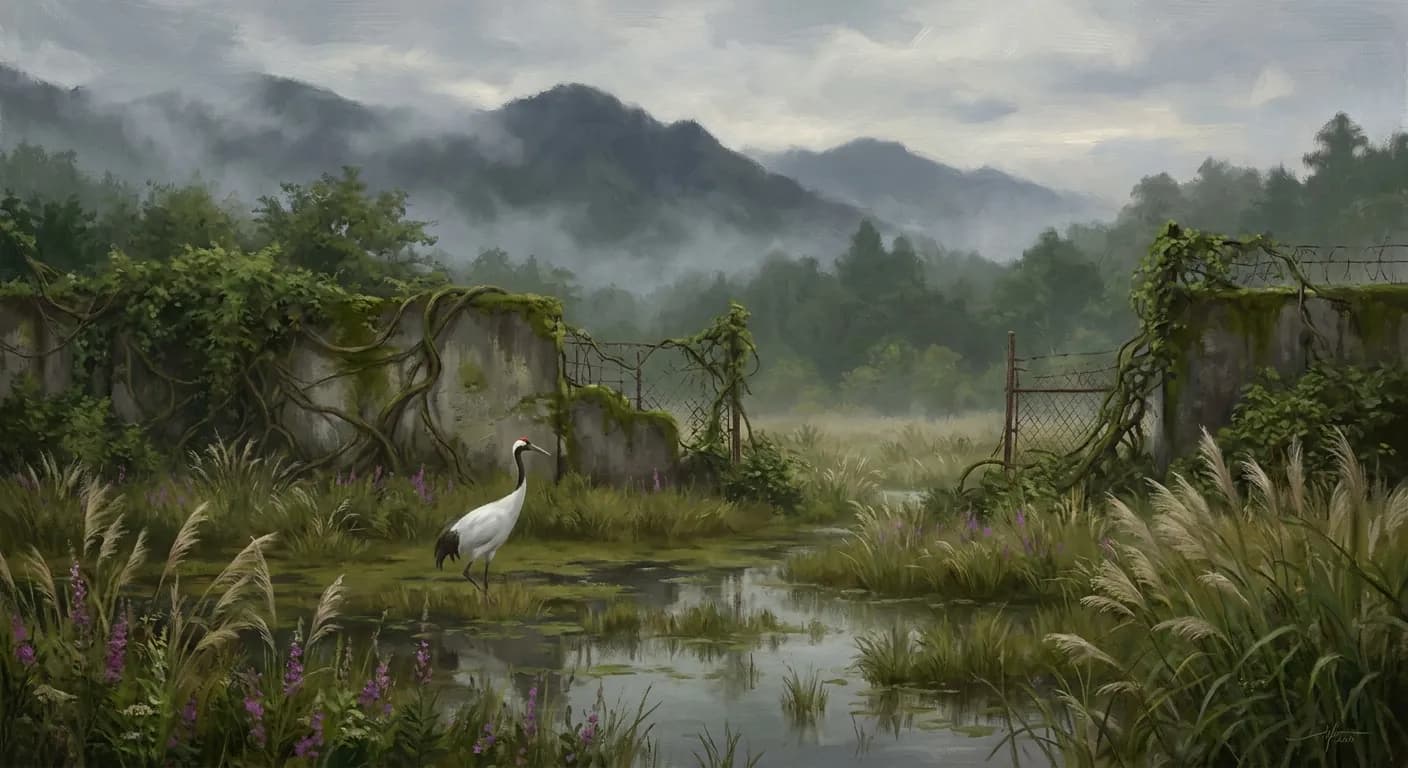
Every November, when the Siberian cold pushes south, thousands of cranes descend on the Cheorwon Basin at the western edge of the DMZ. Seven of the world's fifteen crane species have been documented here, but the stars are two: the red-crowned crane, with its white body and scarlet cap—a symbol of longevity in Korean culture for a thousand years—and the white-naped crane, slightly smaller, slightly less famous, equally magnificent. During the winter months, 30% of the world's wild crane population congregates in this single place.v
Their daily routine is an act of absurdist theater. During the day, the cranes fly south across the demarcation line into the Civilian Control Zone—the additional buffer stretching 5 to 20 kilometers south of the DMZ—where a small number of farmers are permitted to grow rice under the watchful eyes of armed soldiers. The cranes forage in the post-harvest paddies, picking through the leftover grain. Then, at dusk, they fly back north into the DMZ itself to sleep. They roost in the shallow waters and marshes of the mine-filled no-man's-land, where no human being would dare follow them. They have, without irony, chosen a minefield as a bedroom because it is the safest place they know.
The site where they sleep was, during the Korean War, the vertex of the Iron Triangle, ground zero for some of the bloodiest fighting of the conflict, including the Battle of White Horse. And before that—a thousand years before the first shot was fired—it was the capital of the Taebong kingdom, founded in 901 CE by Gung Ye, a one-eyed Buddhist monk turned tyrant who claimed to be the living Maitreya Buddha. The ruins of his palace still exist somewhere in the undergrowth inside the DMZ, entirely inaccessible, slowly dissolving back into the forest floor. The cranes walk over it all—the palace, the trenches, the unexploded ordnance—with the lordly indifference that only birds seem capable of.
Today, the farmers of Cheorwon collaborate with ornithologists, allowing scientists to place trail cameras in their rice fields to monitor the cranes. Visitors can take a monorail to observation decks and watch the birds through telescopes. But guides are careful to remind birdwatchers of a surreal detail: North Korean soldiers on Mount Oseong are simultaneously observing them through binoculars, noting the color of their clothes and the license plates of their cars. You watch the cranes. The cranes watch the fields. The soldiers watch you. Everyone is watching everyone, and the cranes are the only ones who don't seem to mind.
Landmines as Conservationists
Here is a sentence that is factually accurate and morally disorienting: landmines have become the greatest protectors of wildlife on the Korean Peninsula.
Roughly two million mines lie buried in the DMZ—approximately 1.2 million planted by South Korea (M14, M15, and M19 anti-tank and anti-personnel models) and an estimated 800,000 by North Korea, including the notoriously difficult-to-detect wood-encased “Schu” mines.vi These mines were laid to kill people. They have succeeded, over the decades, in killing quite a few. But their primary ecological effect has been to create a barrier of terror that keeps developers, farmers, poachers, and hikers out. The mines do not care about conservation. They are not selective. They simply make the land uninhabitable for anything heavy enough and clumsy enough to trigger a pressure plate—which, overwhelmingly, means us.
The animals have adapted. Asiatic black bears—identifiable by the white crescent moon on their chests—have been photographed by NIE surveillance cameras wading through streams inside the zone. Amur leopards, among the rarest cats on Earth, have been spotted on camera traps. Long-tailed gorals, a goat-like creature sometimes called a “fossil animal” because of its ancient lineage, survive by spending most of their time absolutely motionless on mountain ledges. Scientists have noted that this behavior, while making for spectacularly boring video footage, represents an extreme evolutionary advantage in a habitat laced with tripwires and explosive devices.vii Stillness, in a minefield, is survival.
There are persistent rumors of the Siberian tiger—the great ghost of Northeast Asian megafauna—moving through the eastern mountains of the DMZ. No verified sighting has been confirmed, but the rumors refuse to die, and wildlife biologists admit the habitat could support a transient individual. The thought of a tiger pacing through a minefield, stepping precisely between devices meant for human wars, is the kind of image that belongs in a novel by Cormac McCarthy. It is probably not happening. But the fact that it could happen, that the habitat is wild enough to make it plausible, tells you everything you need to know about what seventy years of human absence can do.
South Korean military authorities, for their part, have settled into a quiet complicity with this arrangement. They avoid extensive research into the degradation of the landmines because they do not want to be legally compelled to clear them. South Korea does not engage in humanitarian demining in the DMZ area. The military uses the mines to limit human mobility—which, as an unintended side effect, maintains the ecosystem.viii It is a conservation strategy that no environmentalist would ever propose and no government would ever admit to, and it works better than almost anything that has been deliberately designed.
Listening to What You Cannot See
Because researchers cannot walk through the DMZ's forests—because walking through them could kill you—they have had to invent new ways of knowing what lives there. The result is some of the most creative ecological science being done anywhere on Earth.
Camera traps are the workhorse technology. Motion-triggered devices, mounted on trees at the zone's edges and occasionally placed inside by military personnel willing to accept the risk, have produced a treasury of images. In one landmark capture, an NIE camera recorded the first verifiable evidence of a young Asiatic black bear inside the DMZ—a glossy-coated juvenile with the characteristic crescent marking, wading across a stream with the unconcerned air of an animal that has never seen a human being.ix For ecologists, it was the equivalent of a moon landing photograph—proof of life in a place you cannot physically reach.
But perhaps the most evocative approach is acoustic. A project called dB@DMZ deploys microphones to record the ambient soundscapes of the mountains, identifying species strictly by audio. Birdsong, insect stridulation, the rustle of mammals in undergrowth—all of it analyzed through machine learning algorithms that can distinguish species by their acoustic signatures. It is ecology by ear, a science built on the recognition that sometimes you can learn more about a place by closing your eyes and listening. In 2024 and 2025, with physical access permanently stalled by the collapse of inter-Korean diplomacy after the failed 2019 Hanoi Summit, researchers have increasingly turned to satellite data, remote GIS mapping, and these acoustic installations to model biodiversity within the zone.
Seung-ho Kim, director of the DMZ Ecology Research Institute, has spent over twenty years working out of Paju, near the border. Every week, he and a small team of volunteers enter the heavily restricted Civilian Control Zone to conduct field research. Because he cannot enter the actual DMZ, Kim builds what he calls “microhabitats” in the CCZ—small rock piles placed near rice paddies—to see if mice, snakes, and reptiles will use them as wildlife corridors, bridges between the wild interior of the DMZ and the agricultural lands beyond its edges. He stacks rocks to see if life will cross. It is patient, humble work. Kim describes looking out over the DMZ's green expanse and says simply: “Over there, it used to be an artillery range, but since they stopped firing, the nature has become so beautiful.”x
The Dread of Peace
I need to say something uncomfortable now, because this story demands it: conservationists are afraid of peace.
Not in any crass or heartless way. Nobody who studies the DMZ's ecology is rooting for continued geopolitical hostility. But the honest scientists will tell you, often off the record and sometimes on it, that reunification could be the worst thing that ever happened to this ecosystem. If the border opens, the mines are cleared, and the two Koreas begin to merge their economies, the DMZ will face the same pressures that have destroyed habitat everywhere else on the peninsula: farming, roads, urbanization, resource extraction. Conservationists worry that “peace will bring back farming and population, and that if North Korea's economy collapses, refugees would flood the zone.” The very act of clearing the landmines would destroy the accidental wilderness they protect.
This paradox has generated decades of proposals and counter-proposals. As early as 1966, someone first suggested turning the DMZ into a national park. In the early 2000s, Nelson Mandela endorsed the idea, drawing parallels to South Africa's transfrontier peace parks. In August 2005, CNN founder Ted Turner traveled to both North and South Korea to advocate for transforming the DMZ into a UNESCO World Heritage site and peace park. He pledged financial support and said bluntly: “We've got to preserve it from development.”xi
None of it went anywhere. When South Korea formally proposed creating a UNESCO biosphere reserve in 2011, North Korea blocked it aggressively, claiming the initiative violated the 1953 Armistice Agreement and accusing the South of using the park as a plot to “permanently divide the Korean Peninsula.” The North saw conservation language as political code—an attempt to normalize the border as a permanent feature rather than a temporary wound. And in a way, they were not entirely wrong. To call the DMZ a “nature preserve” is, implicitly, to suggest that it should stay. That it is worth keeping. That the division it represents has produced something of value. For a regime that officially considers the border an illegitimate imposition, this is intolerable.
The 2018-2019 diplomatic thaw briefly raised hopes. A small number of guard posts were dismantled, some mines were cleared near Arrowhead Hill, and there were plans to open the Han River Estuary to joint use. Then the Hanoi Summit collapsed, Kim Jong Un and Donald Trump walked away from each other, and the freeze returned harder than before. The guard posts remain dismantled. The rest of the DMZ remains untouched. The cranes continue to arrive every November.
The Vocabulary of Absence
There is a word in ecology—“rewilding”—that usually implies deliberate human effort. You reintroduce wolves to Yellowstone. You flood polders in the Netherlands to recreate wetlands. You plant native grasses on former farmland. Rewilding, in common usage, is a project. It has budgets and timelines and stakeholders.
The DMZ represents something different—not rewilding but un-wilding's reversal, a process with no agent, no intention, no plan. The forests grew back because nobody cut them down. The bears returned because nobody shot them. The cranes roost in the marshes because nobody drained them. Every ecological success in the DMZ is an act of omission, not commission. It is the landscape's answer to the question: what would happen if you simply stopped?
This makes the DMZ a deeply strange kind of monument. Most monuments commemorate what humans did. The DMZ commemorates what humans didn't do—couldn't do, because they were too afraid, too hostile, too locked in a standoff that neither side could win or end. The sanctuary exists because of a failure of politics, a failure of diplomacy, a failure of the human capacity to resolve conflict. It is arguably the most beautiful failure in history.
And it belongs to a category of places that I think about more than I probably should: places that are beautiful precisely because they are broken. Pompeii, preserved under ash. The sunken warships that have become coral reefs. The closed military proving grounds where endangered grasses grow on soil saturated with depleted uranium. There is no word for the specific emotion these places provoke—something between grief and wonder, an awareness that the world's capacity for regeneration and the world's capacity for destruction are not opposites but collaborators, working on different timescales toward outcomes that neither controls.
The Garden Nobody Planted
What the strip demonstrates, more purely than any preserve or park or protected wetland on the planet, is that life does not require permission. The forests inside the DMZ waited for no committee. The bears filed no residency application. The cranes negotiated no flyover rights. Life moved into the space that fear had cleared, filled it with roots and feathers and fur, and assembled something so intricate and interdependent that the scientists who study it are reduced to listening from the fence line with directional microphones, inferring an ecosystem they are not permitted to enter.
The lesson runs in two directions at once, and both are uncomfortable. It is reassuring, because it means the damage is not always permanent and the world holds reserves of recovery we habitually underestimate. It is humiliating, because the mechanism was not conservation. Nobody protected this. Two armies made a place too dangerous to farm, log, drain, pave, or visit, and two million landmines did the work that a century of environmental law has not managed anywhere else on the peninsula. The most successful wildlife refuge in Korea is an accident of terror, and it holds only as long as the terror does.
The iron horse at Woljeong-ri Station wants to run again. Maybe someday it will. Maybe the tracks will be rebuilt, the mines cleared, the border dissolved, and Korea will be one country again, whole and healed. I hope so. But I also hope—and this is the uncomfortable hope, the one that sits uneasily in the chest—that when that day comes, someone will have the wisdom to look at what grew in the wound and decide that some of it is worth keeping. That the garden the war made by accident is worth making on purpose. That the cranes, who chose the minefield as their home, deserve to keep it.
Because the DMZ knows something that the generals on both sides have never learned: that the space between enemies, if you leave it alone long enough, becomes the most alive place on Earth.
Sources & Further Reading
- i.Korean Demilitarized Zone — Wikipedia
- ii.Korean Demilitarized Zone: documented species counts and habitat types (Wikipedia)
- iii.Endangered species recorded inside the Korean DMZ (Wikipedia)
- iv.Korean Demilitarized Zone: ecology, endangered species, and the accidental-refuge effect (Wikipedia)
- v.Red-crowned crane: wintering range, population, and the Cheorwon Basin (Wikipedia)
- vi.Landmines in the Korean DMZ — Nautilus Institute
- vii.DMZ Wildlife and Behavioral Adaptations — A-Z Animals
- viii.On de-mining policy and the fate of the DMZ ecosystem, DMZ Forum (no permanent link available)
- ix.Asiatic Black Bear Photographed in DMZ — Korea Herald
- x.Kim Seung-ho and the DMZ Ecology Research Institute, profiled in the Los Angeles Times, April 2018 (link expired)
- xi.Ted Turner's 2005 proposal for a DMZ peace park, reported in the Taipei Times (link expired)
A new exploration goes up most days. Nothing to sign up for.